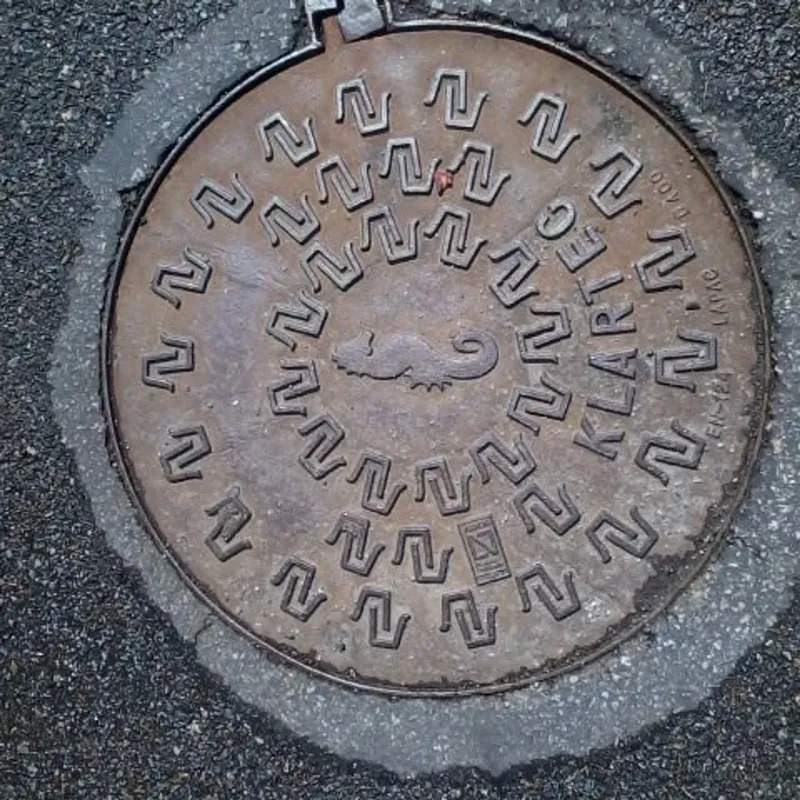
caryfukIn the centre of this specimen is a stylised seahorse, surrounded by a spiral arrangement of geometric elements resembling the letter 'N' or 'Z'. The inscription 'KLARTEC' and the designation 'D400' indicate its robust classification, always a pleasing finding for the study of urban infrastructure. The Institute of Lidology would certainly appreciate this example of functional design with a touch of marine fauna.
CZManhole covers in Czechia
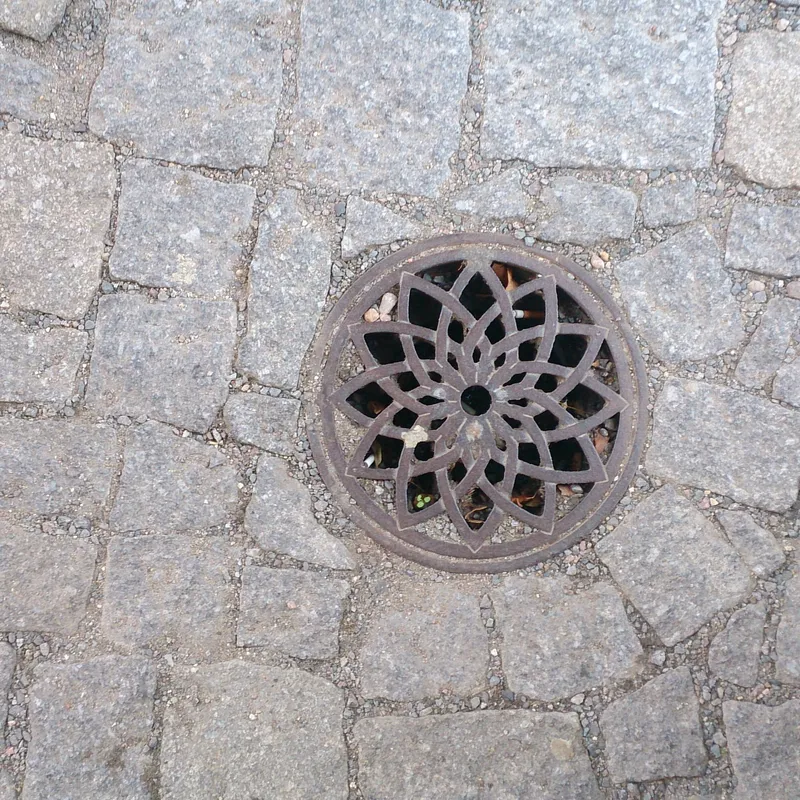
caryfukAn elaborate floral pattern adorns a round metal grate, which is firmly set in paving made of irregular stone blocks. The rusty surface of the metal blends with the grey tones of the surrounding stones and small pebbles filling the gaps. Through the openings of the grate, fallen leaves and small debris are visible, suggesting its drainage function.
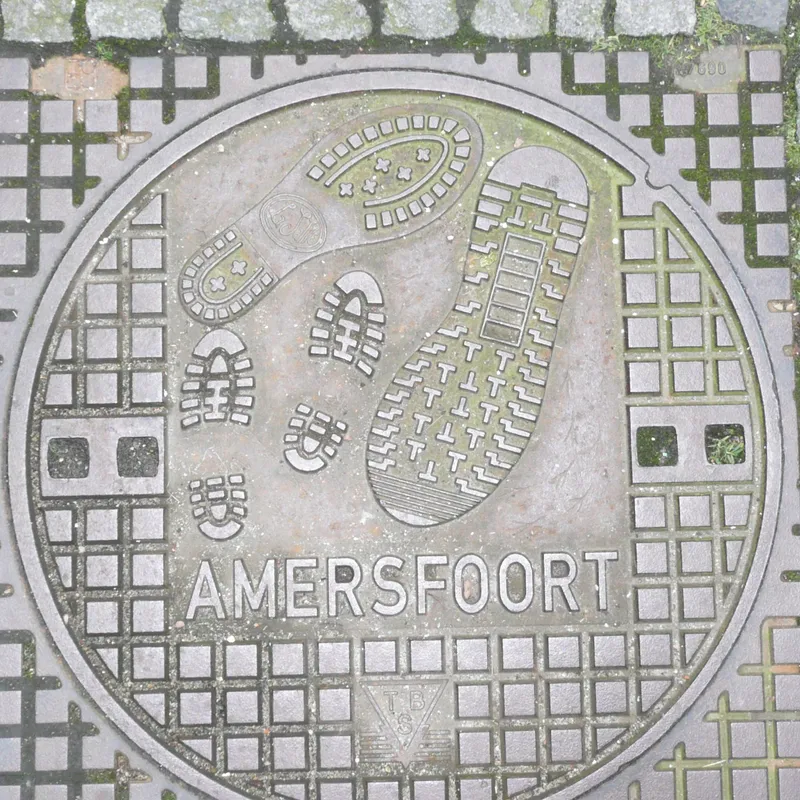
caryfukThis circular example of a cast iron hatch is dominated by the impressions of various shoe soles, indicating its location in an area of high foot traffic. The central field is surrounded by a grid pattern, typical of urban infrastructure and efficient drainage. The presence of the inscription "AMERSFOORT" firmly locates this artefact in a specific Dutch city, making it an interesting object for philological research on urban identity.
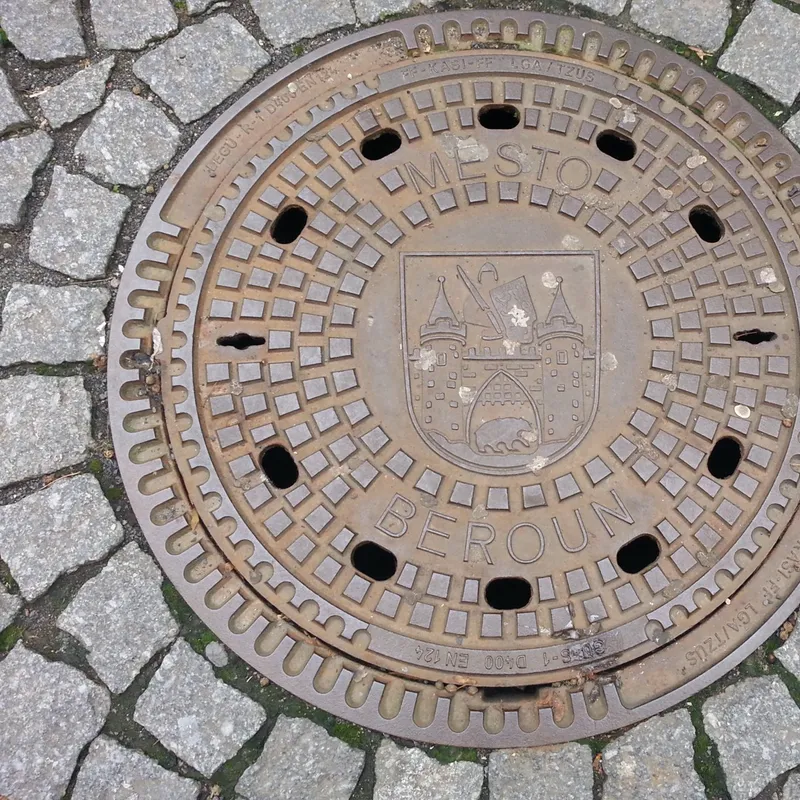
caryfukThis circular cast-iron manhole cover, set into a mosaic of gray cobblestones, proudly bears the coat of arms of the city of Beroun. In the center stands the city’s coat of arms featuring a castle and a bear, surrounded by the inscriptions “MĚSTO” and “BEROUN,” clearly indicating its municipal function. The surface of the manhole cover is dotted with small square protrusions and shows signs of wear and rust, testifying to its long service on the streets.
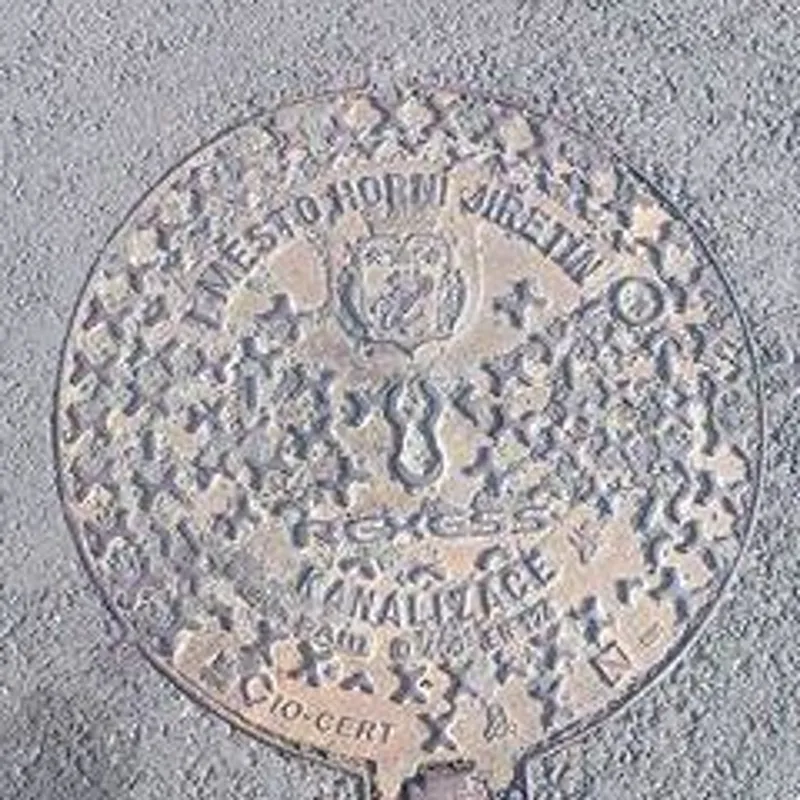
caryfukThe circular surface is adorned with a central city emblem, surrounded by arc-shaped inscriptions and a star pattern along the perimeter. In the lower part, technical specifications and purpose designation are visible, making it an interesting specimen for the study of urban infrastructure. The Institute of Lidology would classify this artifact into the category of communal heraldic elements.
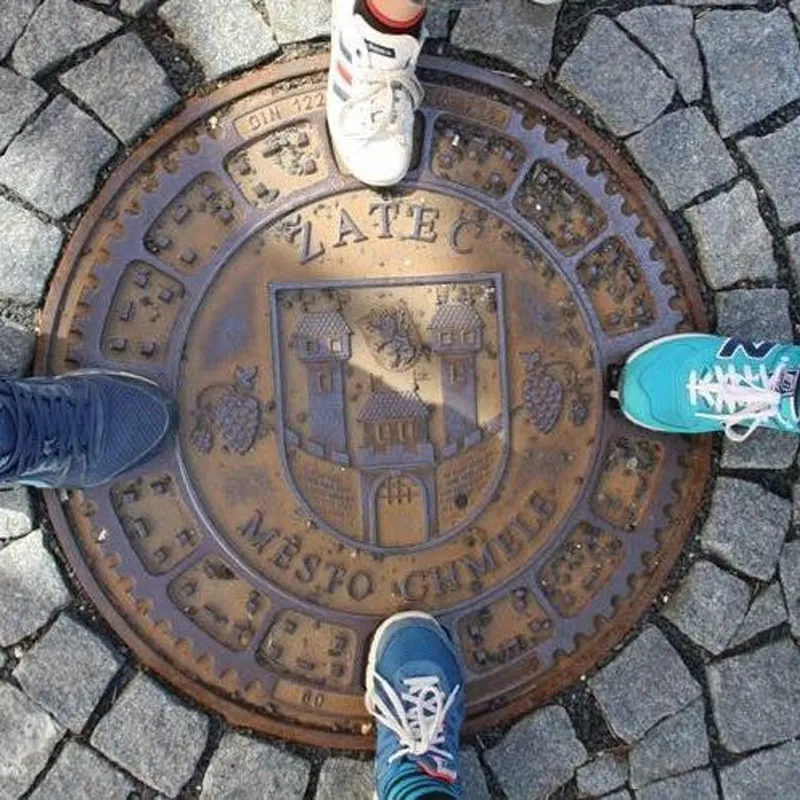
caryfukThe central heraldic emblem, depicting a castle and hop branches, dominates this example of urban infrastructure. The inscriptions "ŽATEC" and "MĚSTO CHMELE" clearly identify its geographical and historical context, which is always a pleasing discovery for the Institute of Lidology. The surrounding paving suggests its location in the historic center, where such artifacts often occur.
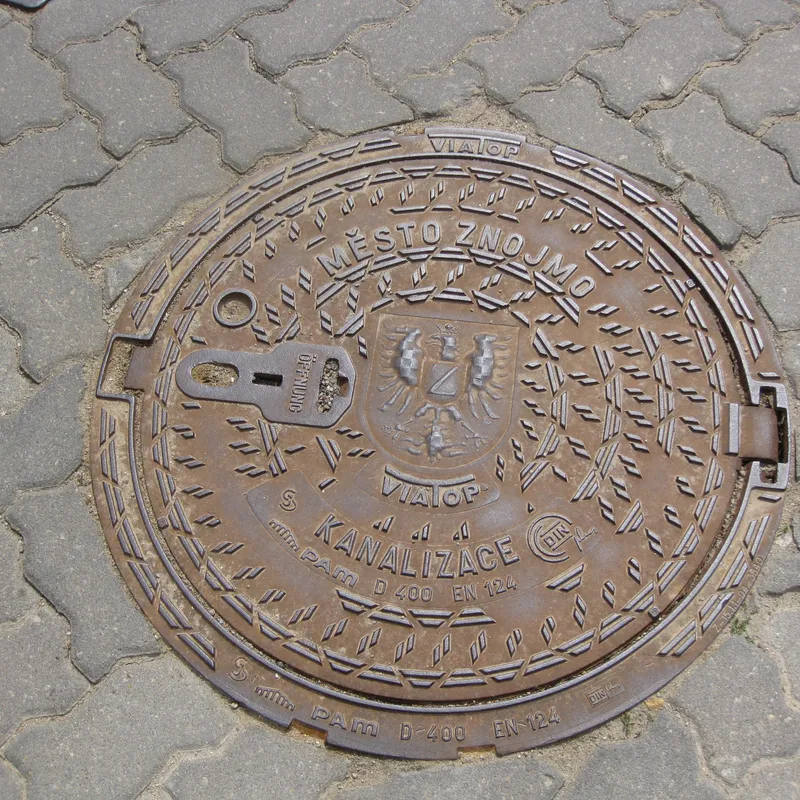
caryfukThe surface of the circular hatch is dominated by a coat of arms with a two-tailed lion and an eagle, surrounded by the text "CITY OF ZNOJMO" and "Sewerage". The rusted patina gives this example an industrial character, while the surrounding paving with wavy joints creates an interesting contrast to its robust design. The Institute of Lidology would note that such artefacts provide valuable insight into communal infrastructure and local heraldry.
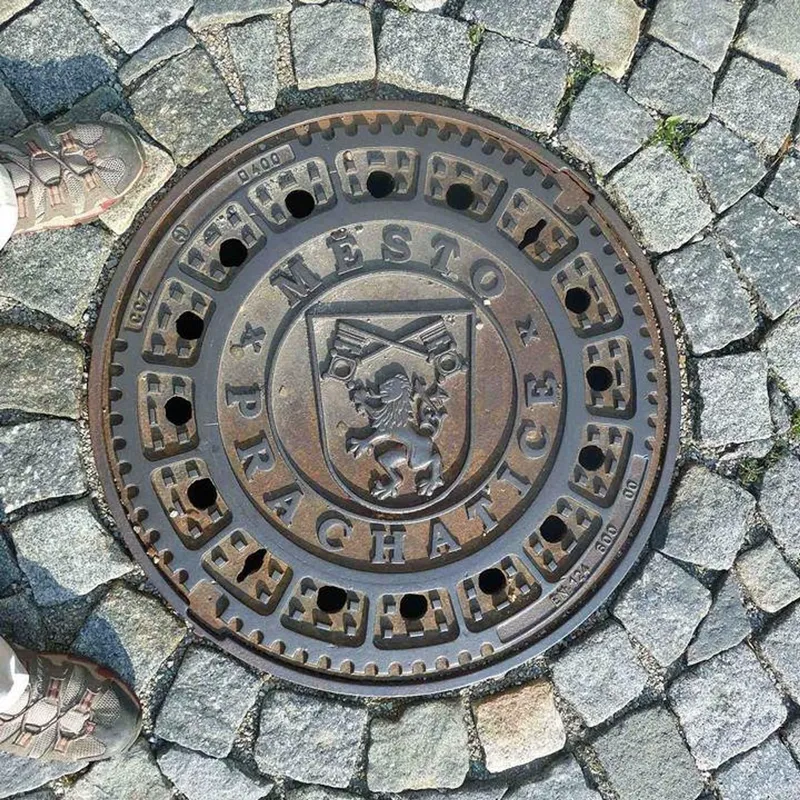
caryfukIn the middle of this specimen, a heraldic lion, symbolizing the City of Prague, majestically towers, surrounded by the inscription "CITY OF PRAGUE". The rim is decorated with a robust geometric pattern and technical data such as "D400", indicating its heavy duty classification. The Institute of Lidology would note that this is a typical example of urban infrastructure with a clear identity.
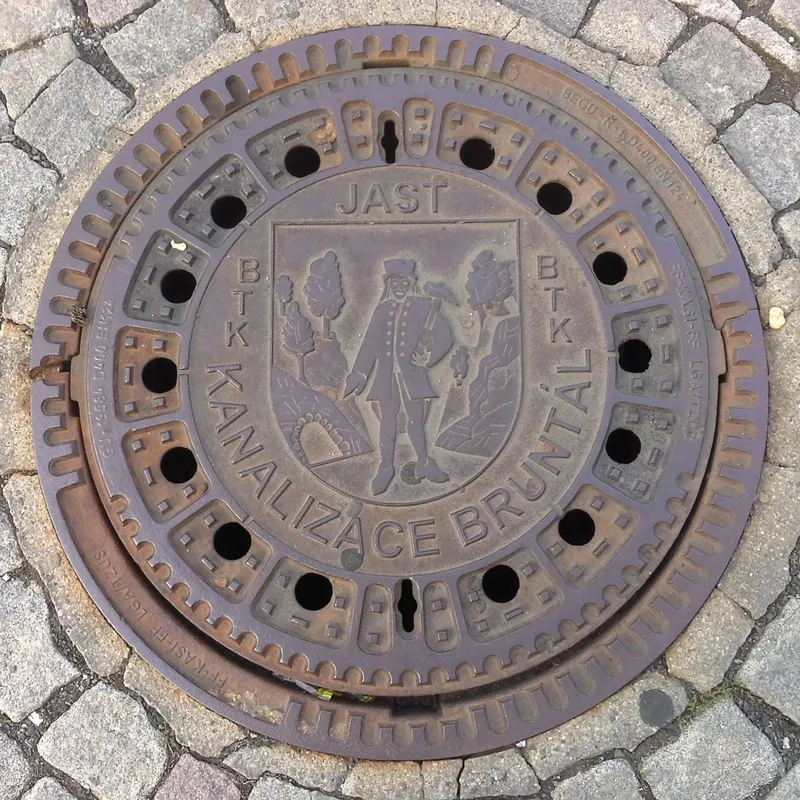
caryfukThe central armorial motif with a figure and trees dominates this example of a cast-iron hatch, indicating its local significance. The surrounding cobblestone paving suggests the historic urban setting where this artefact fulfils its function. Detailed inscriptions around the perimeter provide valuable data on its origin and specifications, which is crucial for philological research.
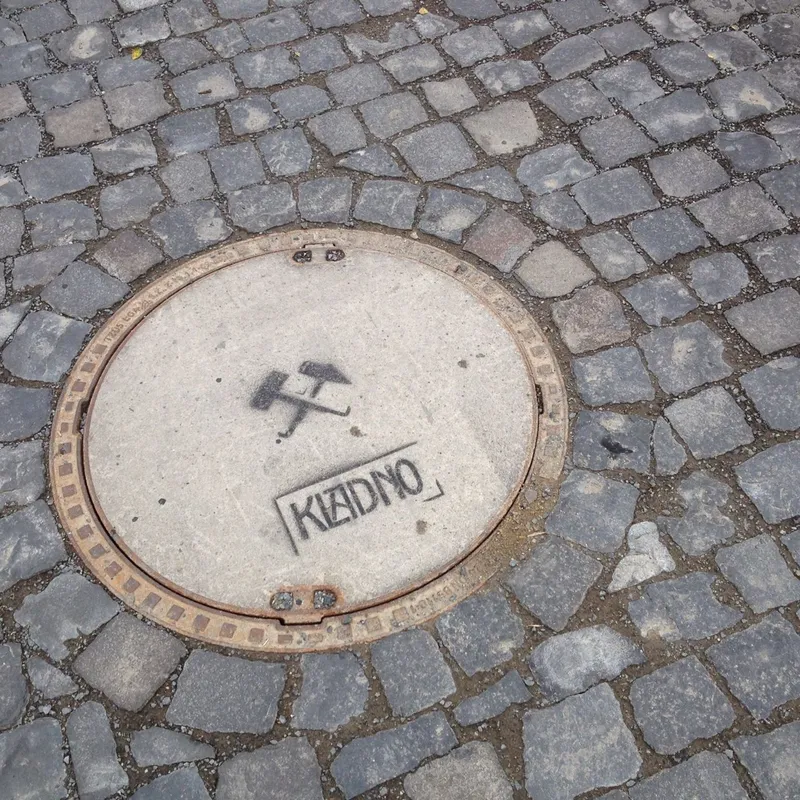
caryfukA pavement of rough stone cubes surrounds this circular specimen, which bears the distinctive symbol of crossed hammers, a traditional mining emblem. The word 'KLADNO' is clearly stamped underneath, suggesting its geographical origin and possible connection with the industrial history of the region. The Institute of Lidology would certainly appreciate this example of functional design with a local narrative, dating from 1992.
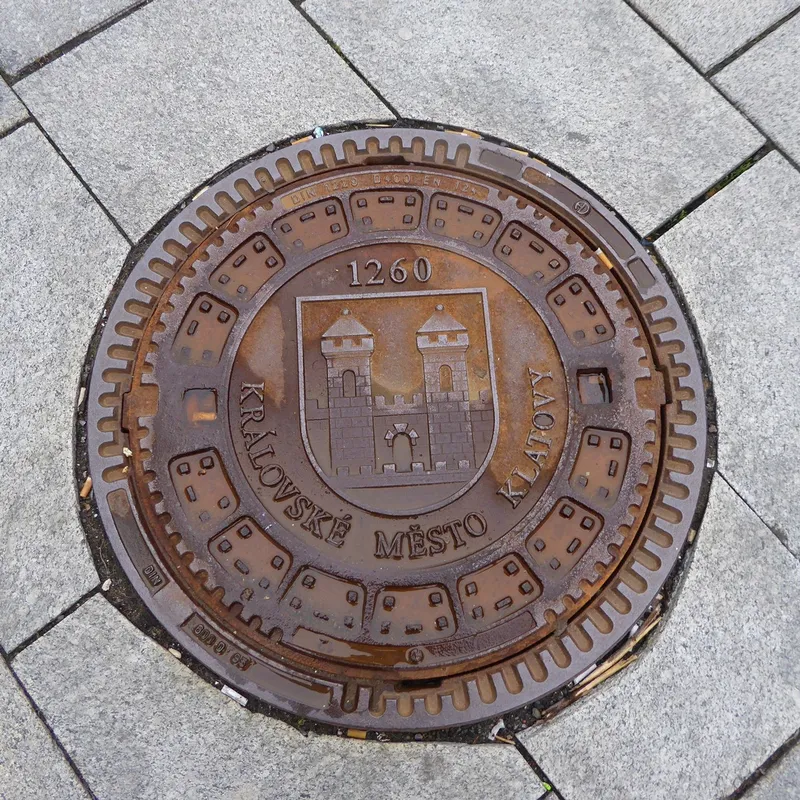
caryfukThe central field of this terrain artefact is dominated by a heraldic shield with a pair of towers, accompanied by the year 1260 and the inscription 'KRÁLOVSKÉ MĚSTO KLATOVY', an obvious reference to the historical status of the site. The peripheral ring exhibits a complex geometric pattern that appears to optimise traction and structural integrity, which is typical of examples of the D400 class. This specific specimen provides valuable data for the study of urban philology, particularly in the context of visual communication with the public.
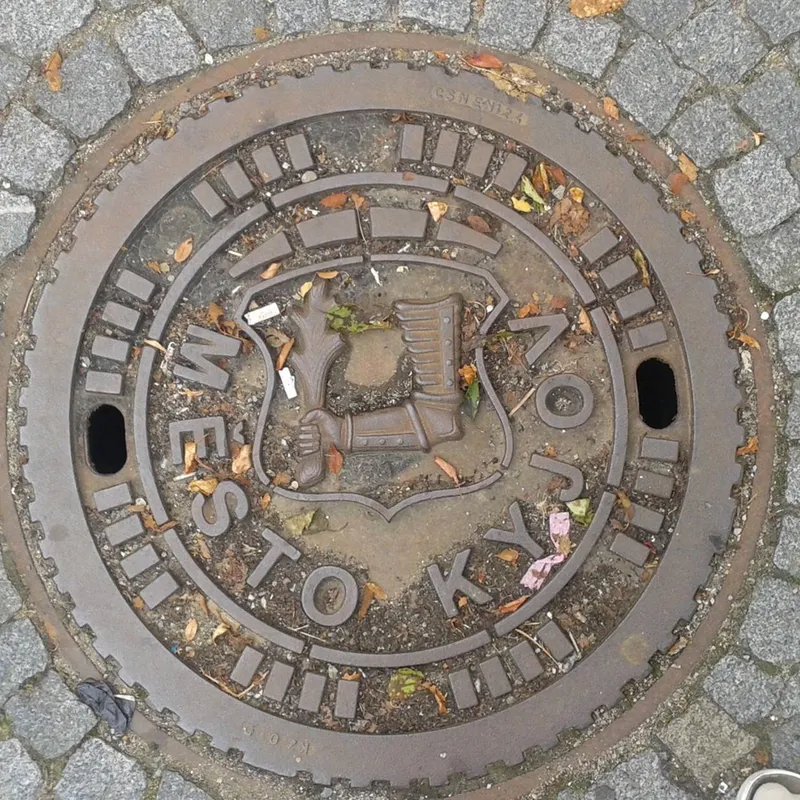
caryfukIn the centre of the paved area is a circular artefact made of cast iron, the central field of which is decorated with a heraldic emblem with a shoe and a branch, surrounded by the inscription "CITY OF KYJOV". This specimen, bearing the standardisation marking ČSN EN 124 and the code D 071, represents an important document of urban infrastructure from the late 20th or early 21st century.
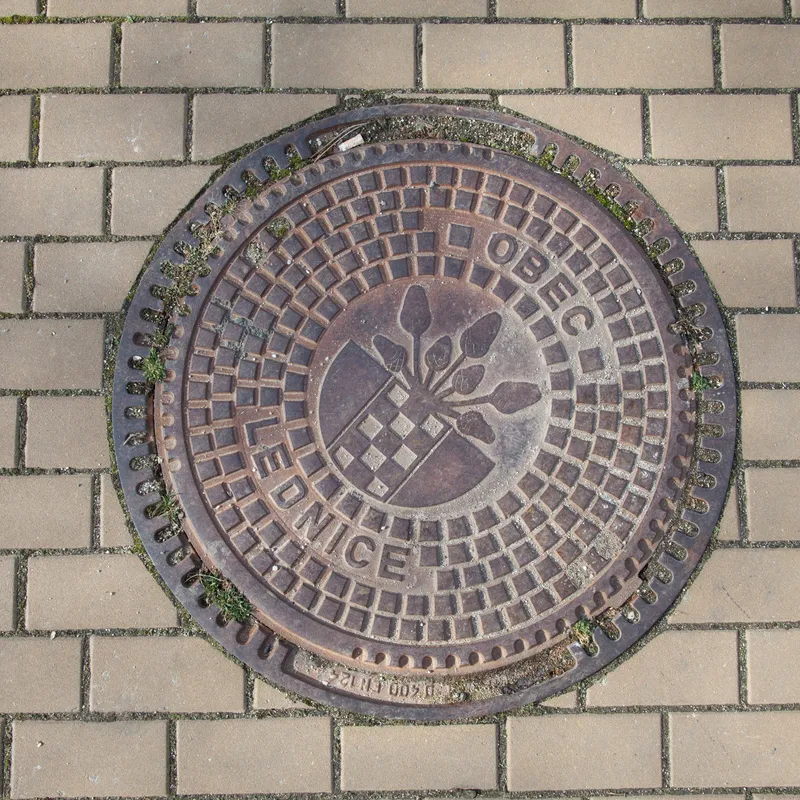
caryfukThe central motif of this specimen, carefully analysed by the Institute of Lidology, represents stylized plant formations, probably tulips, accompanied by a heraldic checkerboard pattern. The text 'Municipality of LEDNICE' extends around this emblem and the outer edge bears the marking 'D 400 EN 124', indicating its load-bearing capacity and standard. The surface shows signs of patina and minor vegetation, indicating its long-term exposure in an urban environment and providing valuable data on the interaction of the material with the local microclimate.
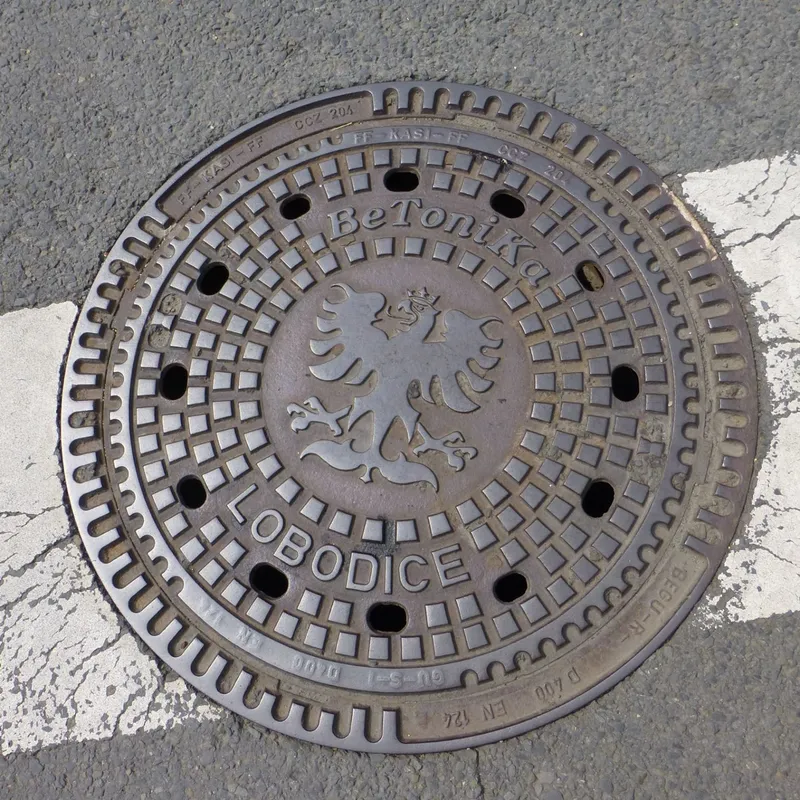
caryfukThe central heraldic motif of an eagle with a crown dominates this example of a cast iron hatch, surrounded by a precise geometric grid. Epigraphic evidence reveals inscriptions such as 'BeTonica' and 'LOBODICE', suggesting both the maker and the likely site of installation. The outer ring then provides the technical specifications necessary for the study of philology.
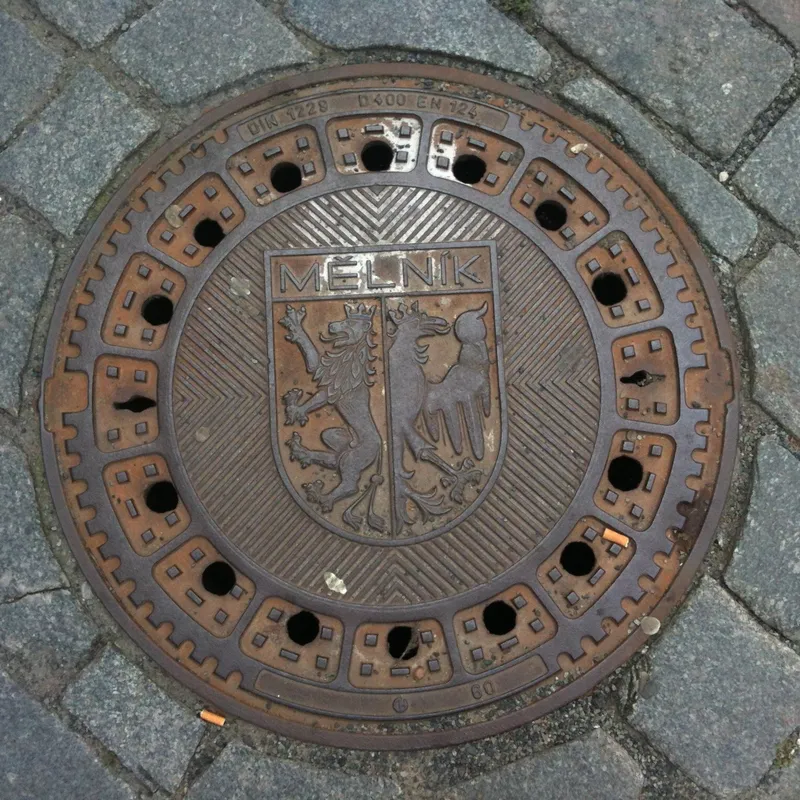
caryfukThe central shield of this specimen bears heraldic animals - a lion and an eagle - and the inscription MĚLNÍK, indicating its geographical origin. The surrounding geometric pattern, reminiscent of a gear, shows signs of wear, which the Institute of Lidology finds fascinating evidence of long-term interaction with the urban environment. Clearly, this artifact fulfills its function with unwavering stoicism.
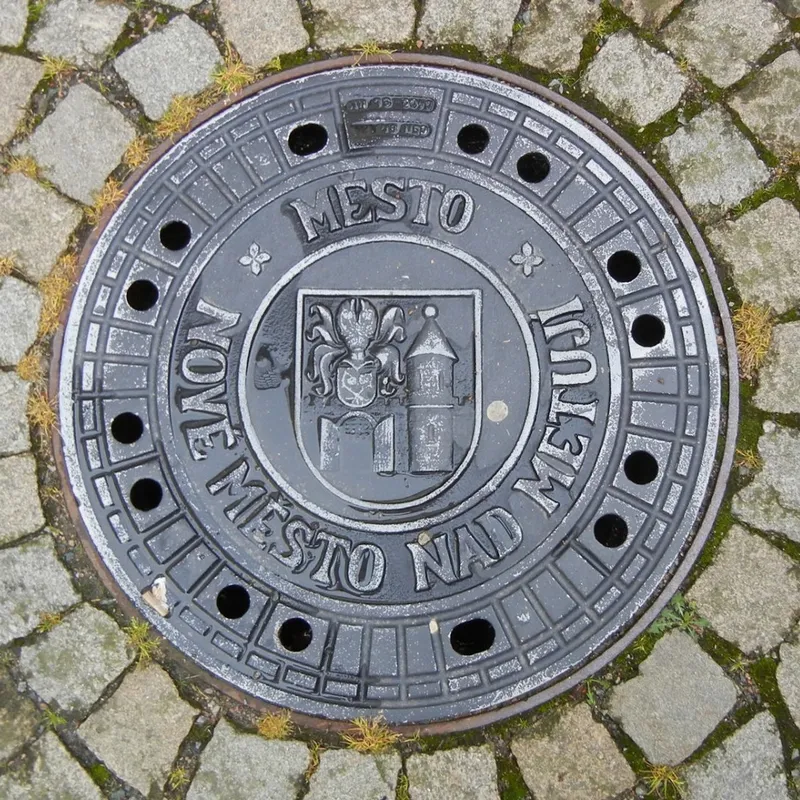
caryfukA central armorial shield with a tower and a stylized octopus dominates this example of urban engineering. The inscription 'NEW CITY OF METHUY' winds around it, surrounded by a grid pattern and a series of circular openings, suggesting its functional purpose in the urban environment. Set in a pavement of irregular stone blocks, this artefact bears the marks of normal wear and tear, but its relief details remain clearly legible.
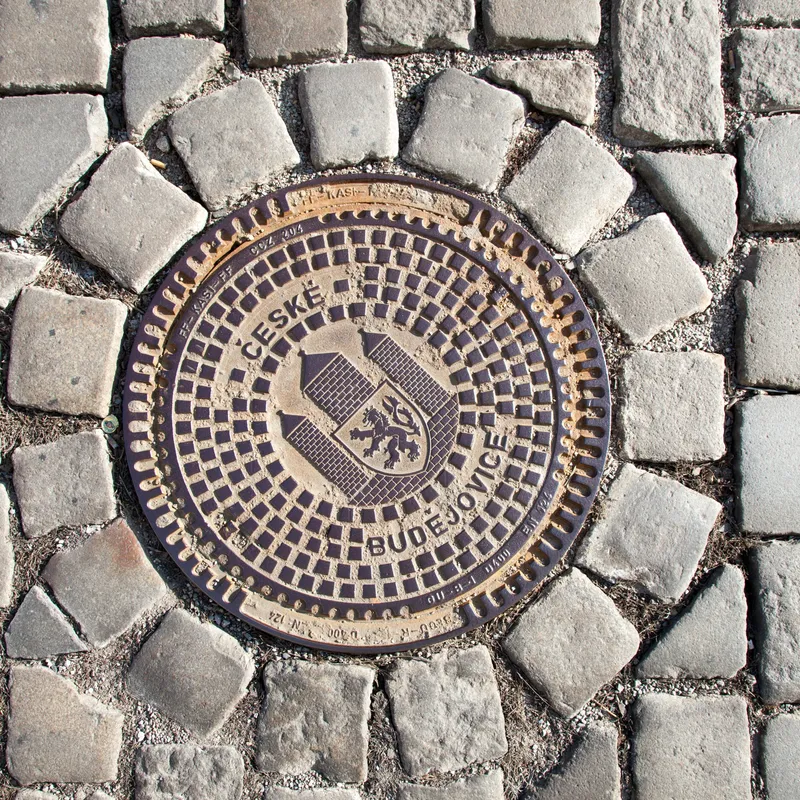
caryfukThe central heraldic motif of a lion in a shield with a tower, surrounded by the inscription "ČESKÉ BUDĚJOVICE", dominates this example of urban infrastructure. The radial arrangement of small squares, typical of D400 class hatches, indicates its robust construction and its functional classification as heavy duty. The surrounding paving of rough stone blocks emphasises its historical context and resistance to environmental influences.
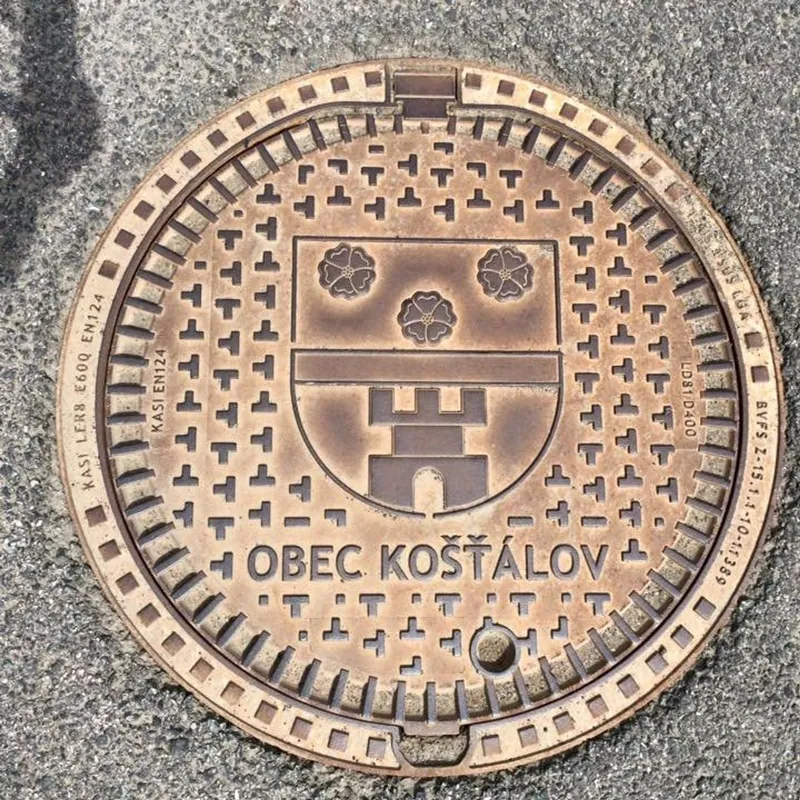
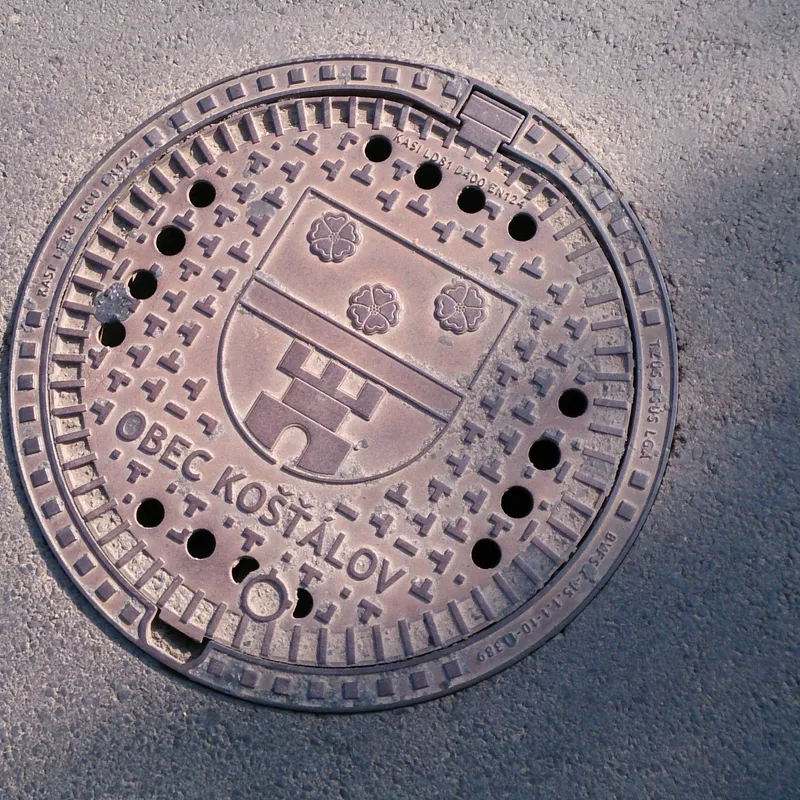
caryfukIn the centre of this specimen is a coat of arms with three stylised flowers at the top and a castle at the bottom, surrounded by a repeating geometric pattern resembling crosses. The rim bears numerous technical specifications and the name of the municipality of Košt'álov, indicating its communal origin. From the point of view of philology, this artefact represents a fascinating record of infrastructural identity.
caryfukA pavement of small cubes surrounds a circular specimen with a distinctive geometric grid pattern. A stylised architectural motif, reminiscent of a castle or historic building, is visible in the centre, giving this feature a certain local identity. Inscriptions such as "SEWER" and "HYDROTEC" clearly indicate its primary purpose and manufacturer, a valuable finding for the Institute of Lidology.
caryfukA regular grid of square holes, arranged with a precision worthy of a guild master, reveals the fascinating depths of the city's sewers beneath. The heraldic emblem of the city of Opava proudly stands out in the middle of this specimen, making it one of the most valuable artefacts of municipal administration. Remnants of yellow paint on some of the holes suggest later, perhaps experimental, markings that would merit further study in the archives of the Institute of Humanology.
caryfukOn a rough asphalt surface lies a circular cast-iron manhole cover, whose central field is heraldically decorated with a coat of arms featuring a wall and three stylized flowers, a typical example of municipal infrastructure. The edge of this artifact is bordered by a series of technical inscriptions and the name of the municipality Košťálov, providing valuable data for lidological classification.
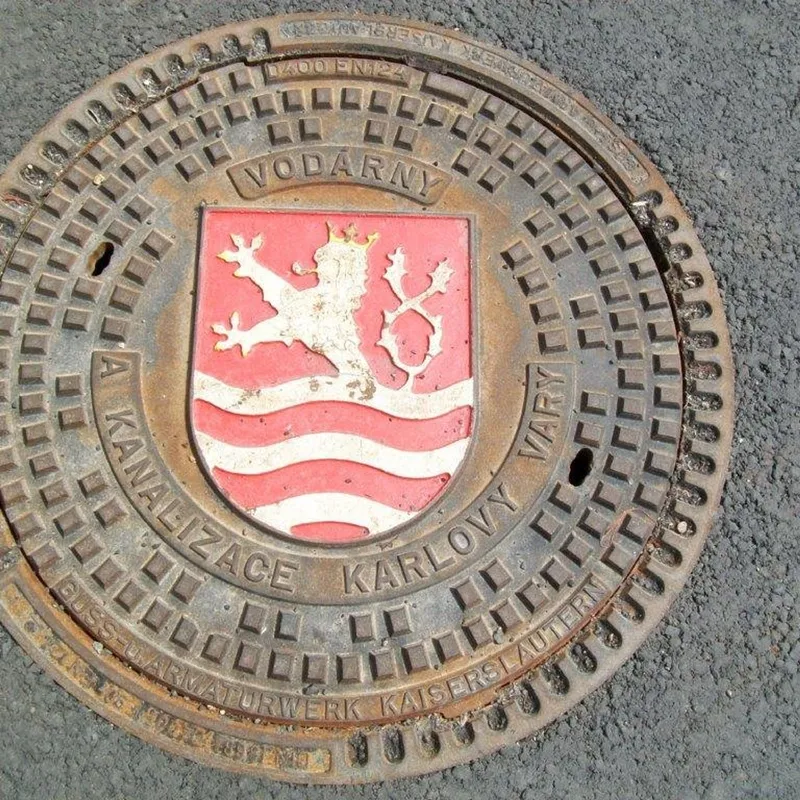
caryfukIn the centre of this specimen is a majestic crest with crowned lion and stripes, surrounded by a circular inscription. The text on the surface, which could be the subject of detailed philological analysis, clearly identifies the purpose and origin of this piece of urban infrastructure.
caryfukThe central heraldic shield, surrounded by a circular inscription and a row of ventilation openings, is a prime example of municipal heraldry applied to cast-iron infrastructure. The surrounding paving of small stone cubes, carefully arranged in a radial pattern, underscores the significance of this artifact in an urban context.
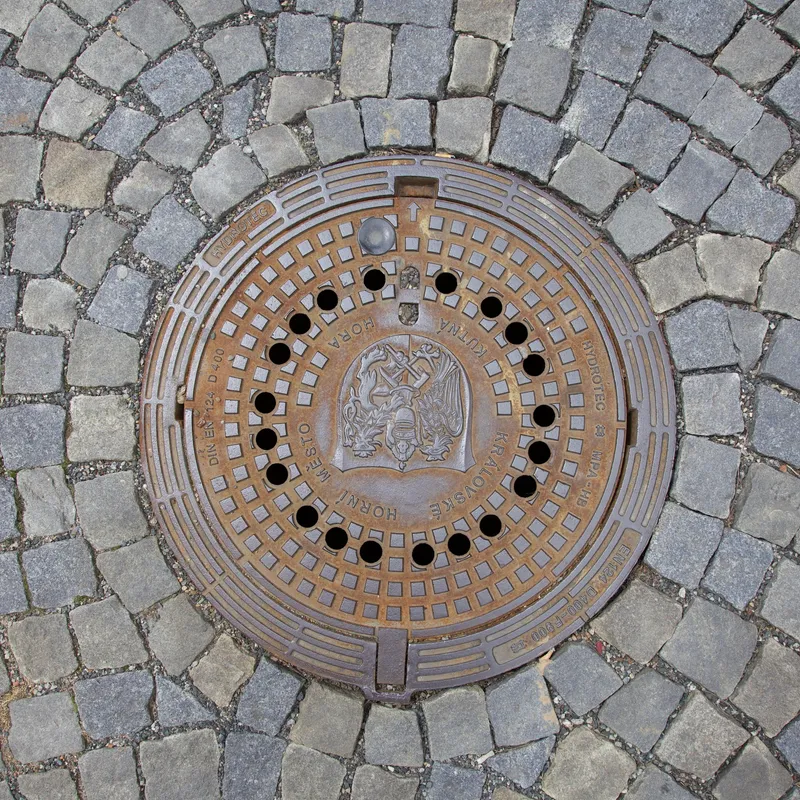
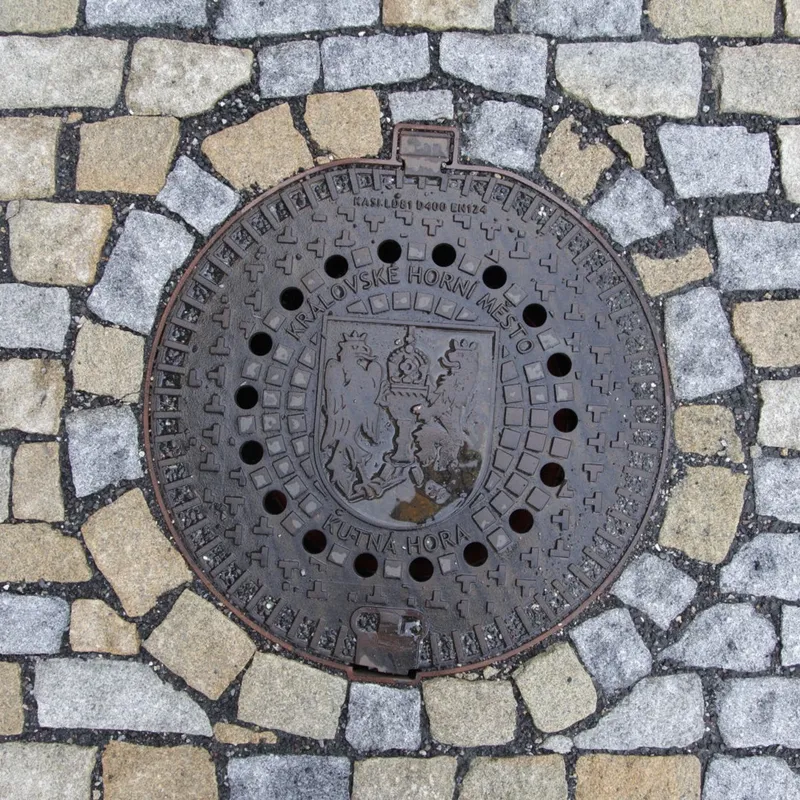
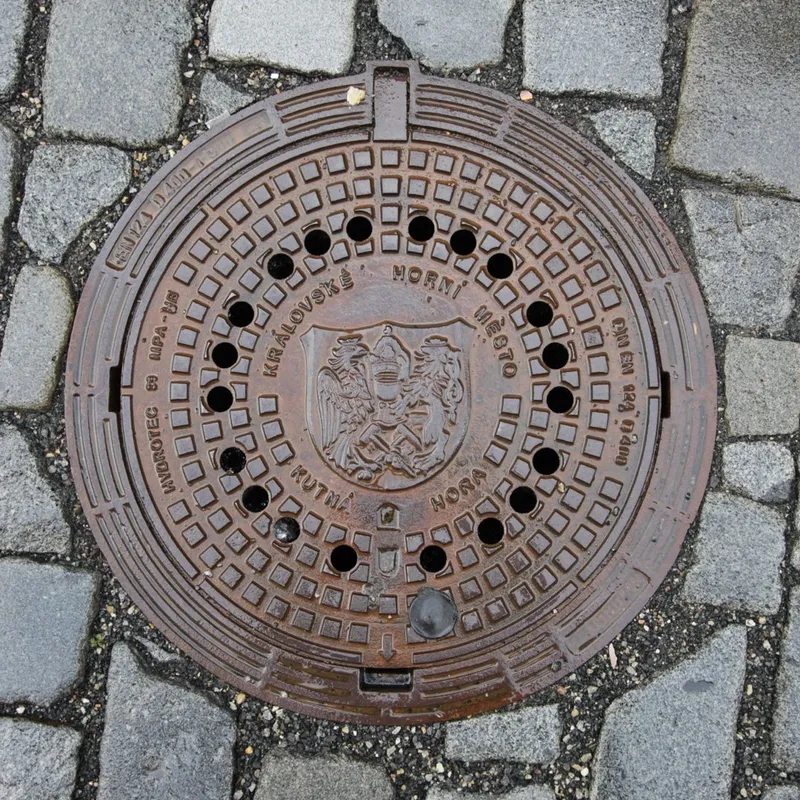
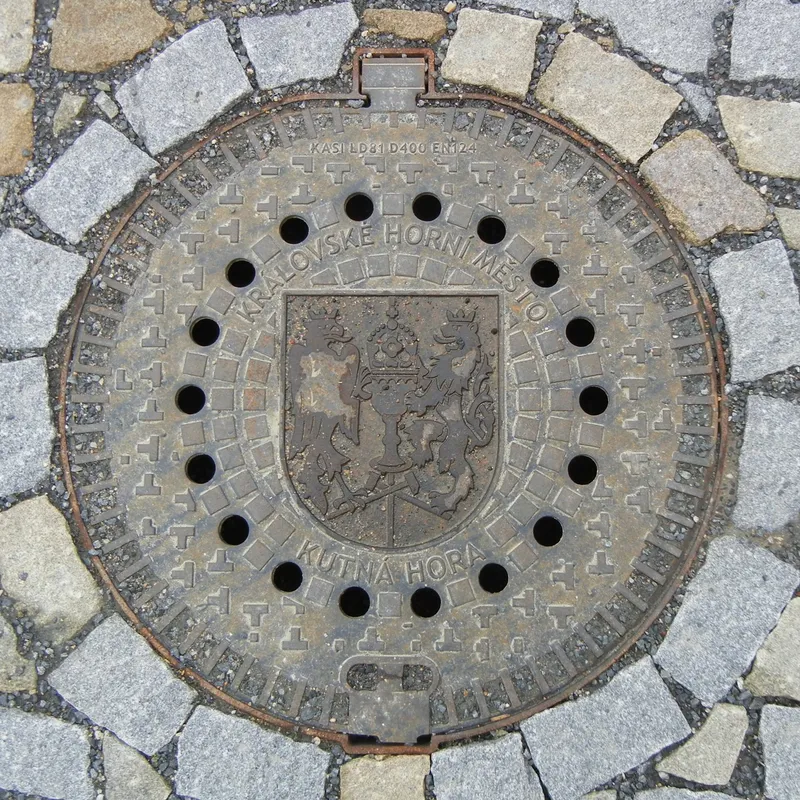
caryfukThe central heraldic emblem, surrounded by the inscription "KRÁLOVSKÉ HORNÍ MĚSTO KUTNÁ HORA", represents the key identifying element of this example of the cast iron hatch plate. The surface morphology, characterised by a regular grid of vents and relief squares, suggests a robust construction for urban loads. Carefully set in a mosaic of stone paving, this artefact serves as a silent witness to urban history.
caryfukIn the centre of this specimen is a detailed municipal coat of arms surrounded by the inscription "KRÁLOVSKÉ HORNÍ MĚSTO KUTNÁ HORA", which clearly identifies its geographical affiliation. The rim is decorated with a regular geometric pattern of small squares and circular holes set in a pavement of rough stones. The Institute of Lidology would note that such a robust structure is crucial to the long-term integrity of the city's infrastructure.
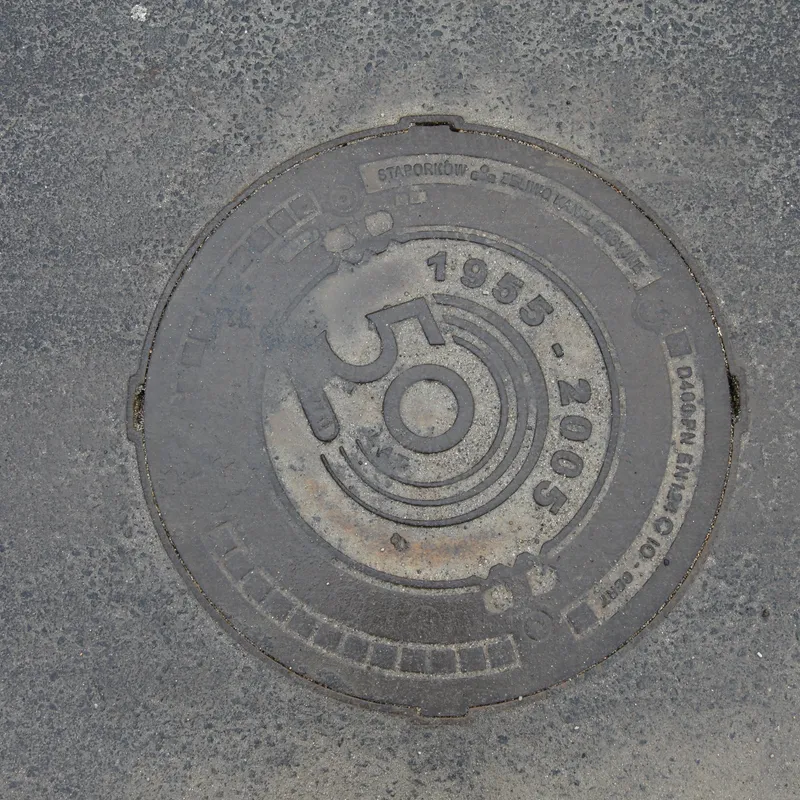
caryfukThe central motif of this specimen is the distinctive number '50', surrounded by the years '1955' and '2005', indicating the 50th anniversary. The outer rim bears the inscription 'STAPORKÓW ŻELIWNE KANALIZACYJNE' and the marking 'D400 PN EN 124 C 10 - GER', providing key information on its origin and technical specifications. The Institute of Lidology is pleased to note that this is a robust cast iron manhole cover that retains its integrity despite years of service.
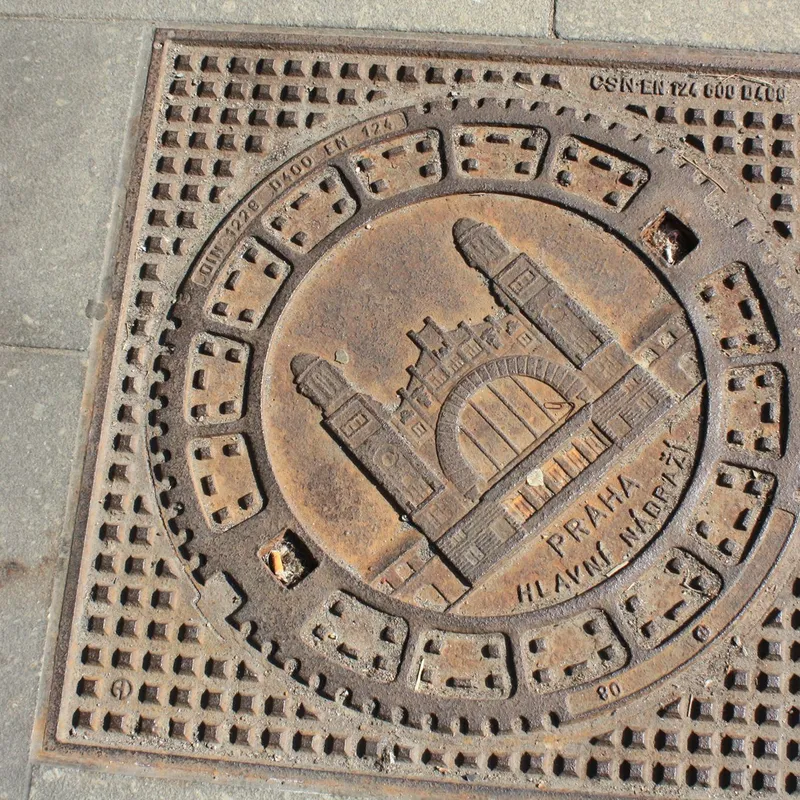
caryfukA central relief depiction, clearly inspired by architecture, dominates this example of urban infrastructure. The inscription 'PRAGUE MAIN ROAD' clearly identifies its geographical and functional affiliation, while the noticeable corrosion gives the surface a patina of historical authenticity. According to the methodology of the Institute of Lidology, such details provide valuable clues about the interaction of the material with the urban environment.
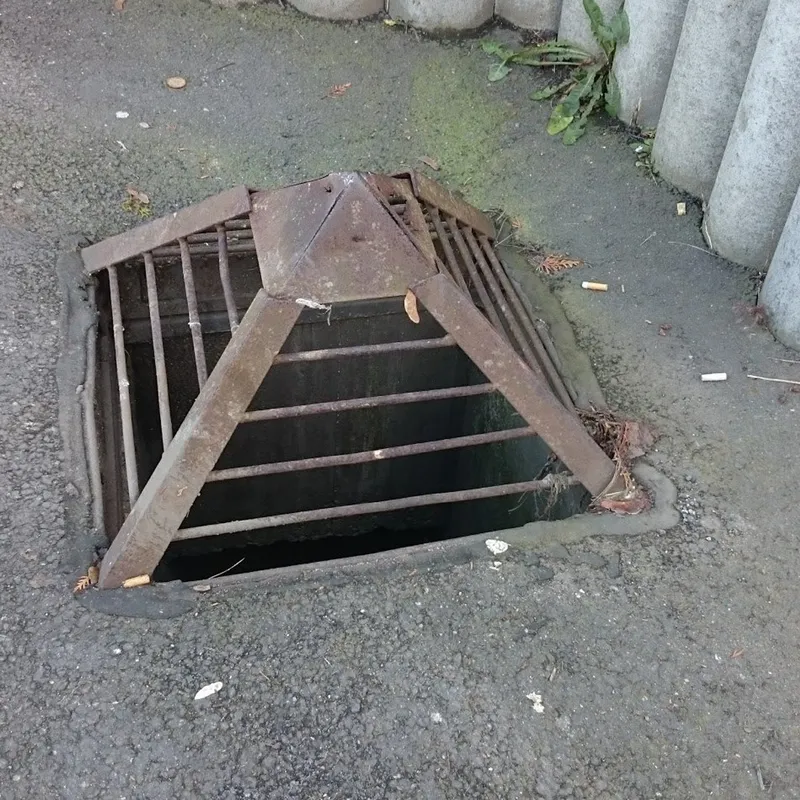
caryfukA rusty metal grating, forming a pyramidal structure, protects the entrance to the underground drainage system. The surrounding asphalt is littered with cigarette butts and small debris, indicating a busy but neglected environment. This specimen represents an interesting case of an ad-hoc solution to protect a drainage opening, worthy of further philological analysis.
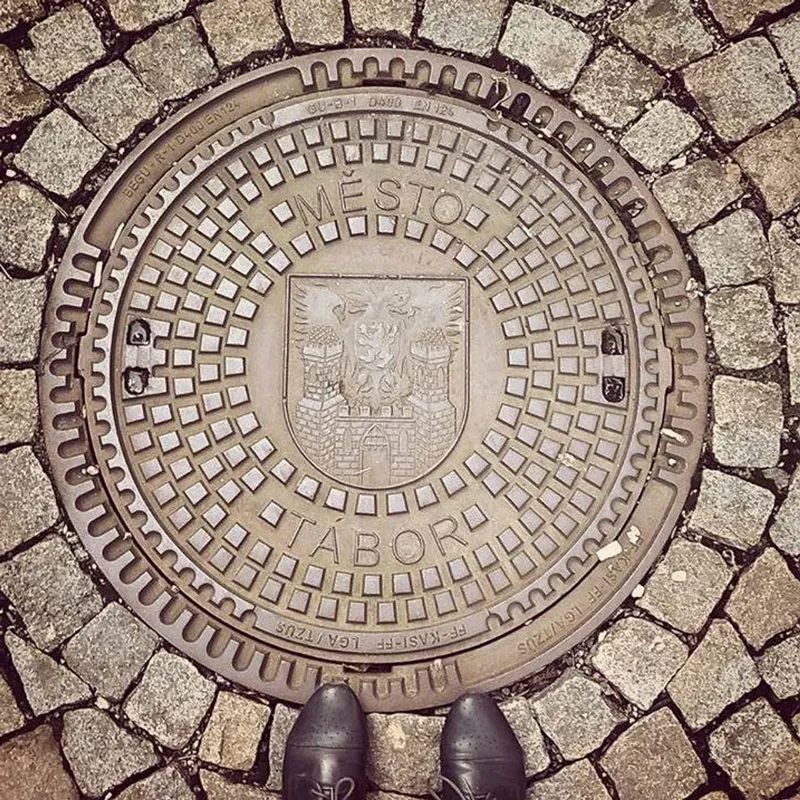
caryfukA circular grid of small squares surrounds the central shield with a depiction of a lion and the town buildings, which is a heraldic element of the town of Tábor. Analysis of the surface texture and inscriptions reveals that this example of urban infrastructure serves the sewerage network and meets the D400 EN124 standard.
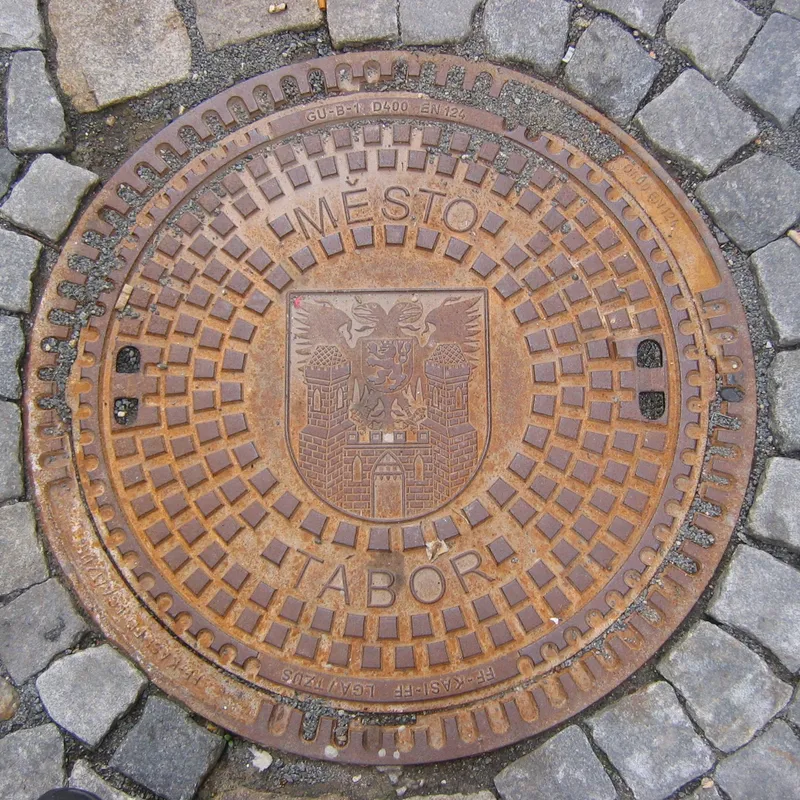
caryfukThis specimen is dominated by the town emblem with a double-headed eagle and stylized buildings, surrounded by the inscriptions "TÁBOR TOWN". The surface shows a regular geometric pattern of squares, partly covered with a patina of rust, indicating its long exposure to atmospheric influences. From a philological point of view, this artefact represents an interesting example of communal infrastructure with heraldic elements.
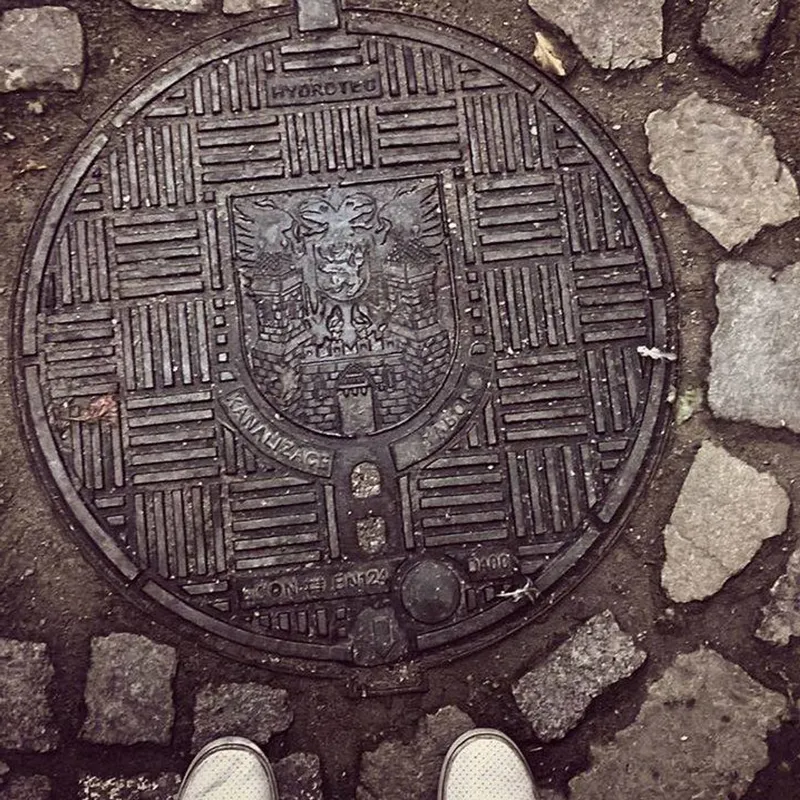
caryfukOn the surface of this metal disc, a complex geometric pattern surrounds a central heraldic motif. This specimen, examined by the Institute of Lidology, displays signs of urban infrastructure, with the inscription 'KANALIZACE' and the coat of arms of the city of Kraków. The inscription 'HYDROTEC' and the classification 'D400' can be seen at the top, indicating its robust construction for high loads.
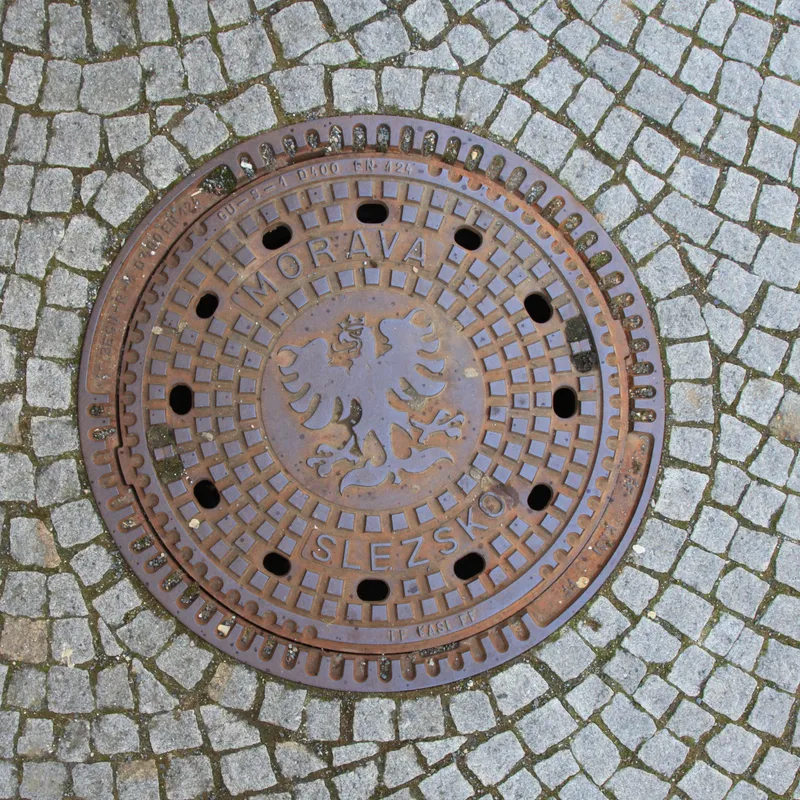
caryfukAgainst the background of rough paving stones is a circular metal artefact, the surface of which is decorated with a heraldic eagle with a crown, symbolizing the historical lands of Moravia and Silesia. The inscriptions 'MORAVA' and 'SLEZSKO' are prominently placed, indicating the regional affiliation of this specimen, which, as the Institute of Lidology suggests, serves to access underground infrastructures. The patina of rust gives this functional element of the street a certain archaeological gravitas.
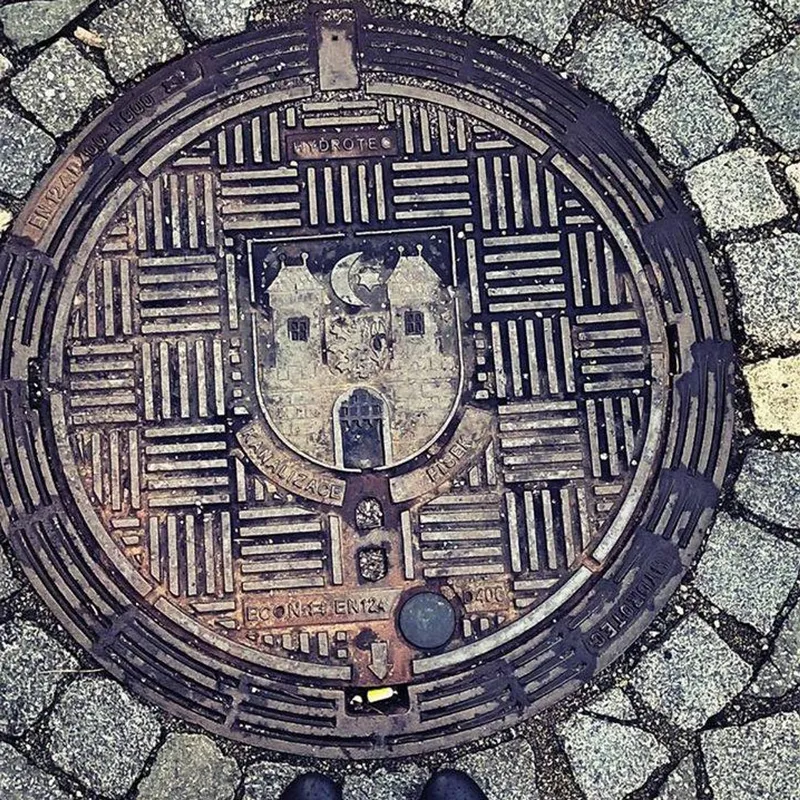
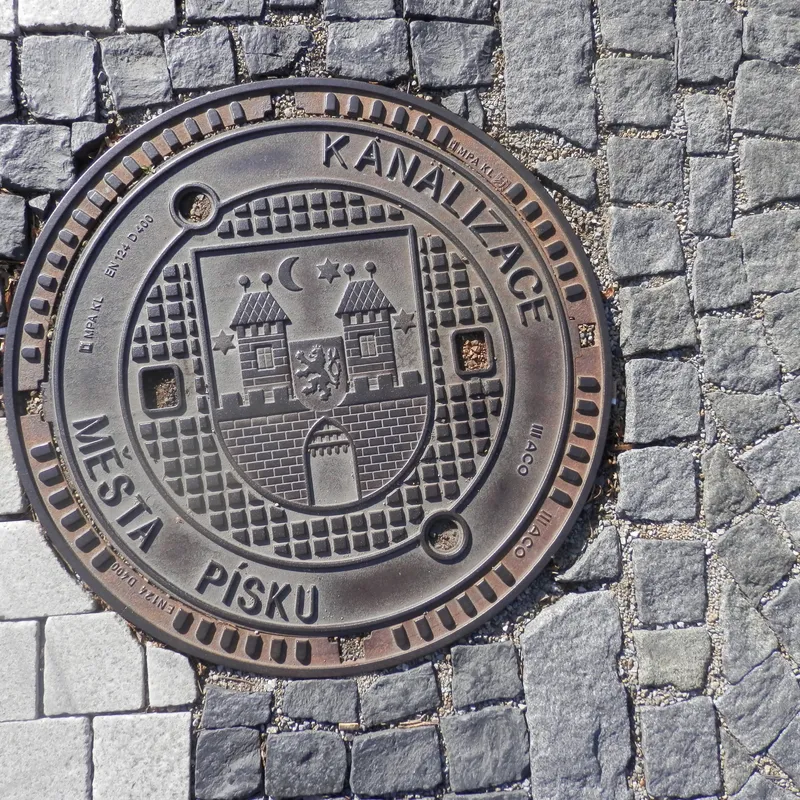
caryfukThe central coat of arms, probably of the town of Písek, dominates this circular hatch, surrounded by a precise geometric pattern. Inscriptions such as "SEWER" and "HYDROTEC" indicate its functional purpose and manufacturer. This specimen represents an interesting combination of urban heraldry and industrial design, worthy of study by the Institute of Lidology.
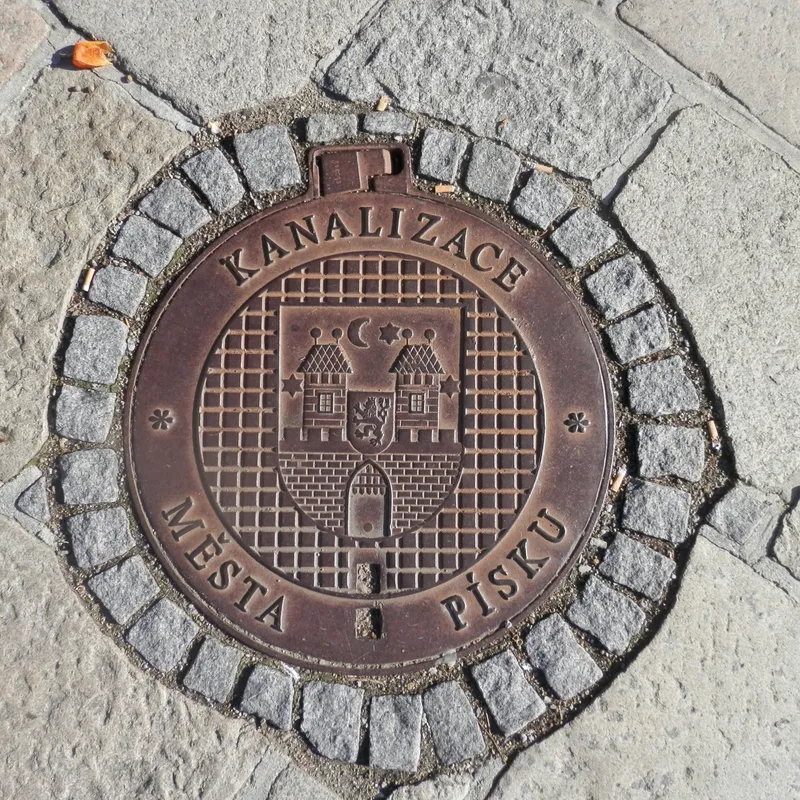
caryfukThe central motif is a detailed coat of arms of the town of Písek, with a castle, heraldic lion, crescent and star, which is a typical element for town hatches. The surrounding pavement of rough cobbles and concrete suggests a historic setting. This specimen is of interest to the Institute of Lidology for its cultural and functional synthesis.
caryfukA central coat of arms with a castle, lion, crescent and stars dominates this example of urban infrastructure, surrounded by inscriptions in Czech. The edge of the hatch is decorated with a regular pattern, suggesting the robust construction and functional design typical of urban sewerage systems. This artefact, carefully set in a pavement of rough stones, is a fascinating study of the philological discourse on public spaces.
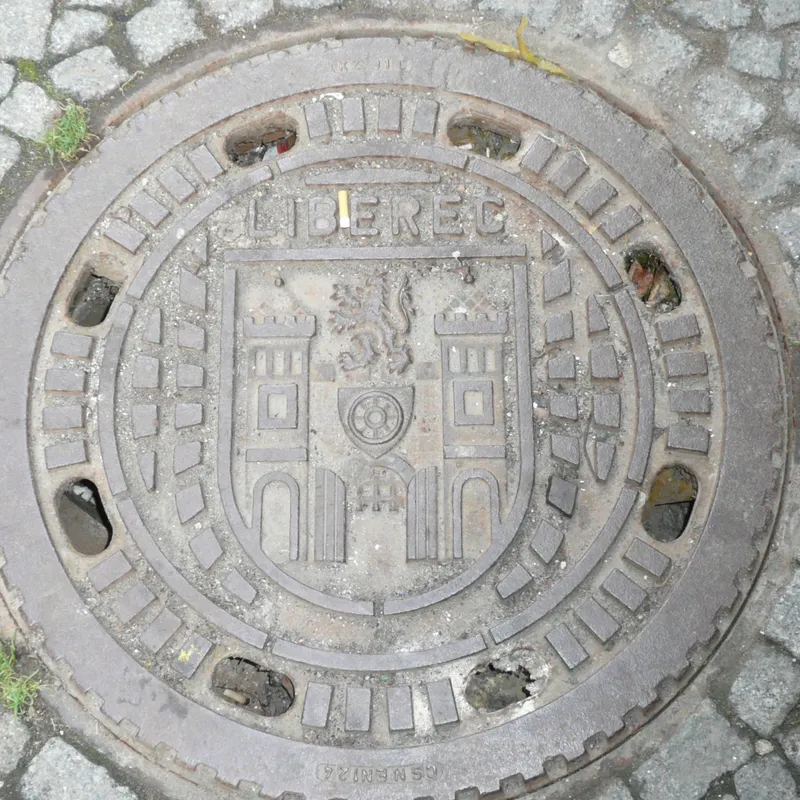
caryfukThe surface of this iron artifact is dominated by the heraldic emblem of the city of Liberec, carefully pressed into the metal. Obvious wear and corrosion processes indicate long-term exposure to atmospheric influences, making it an interesting specimen for the study of material degradation in an urban environment. The presence of cigarette butts and small debris in the vents indicates interaction with human activity, a typical phenomenon for urban manhole covers, as the Institute of Lidology would confirm.
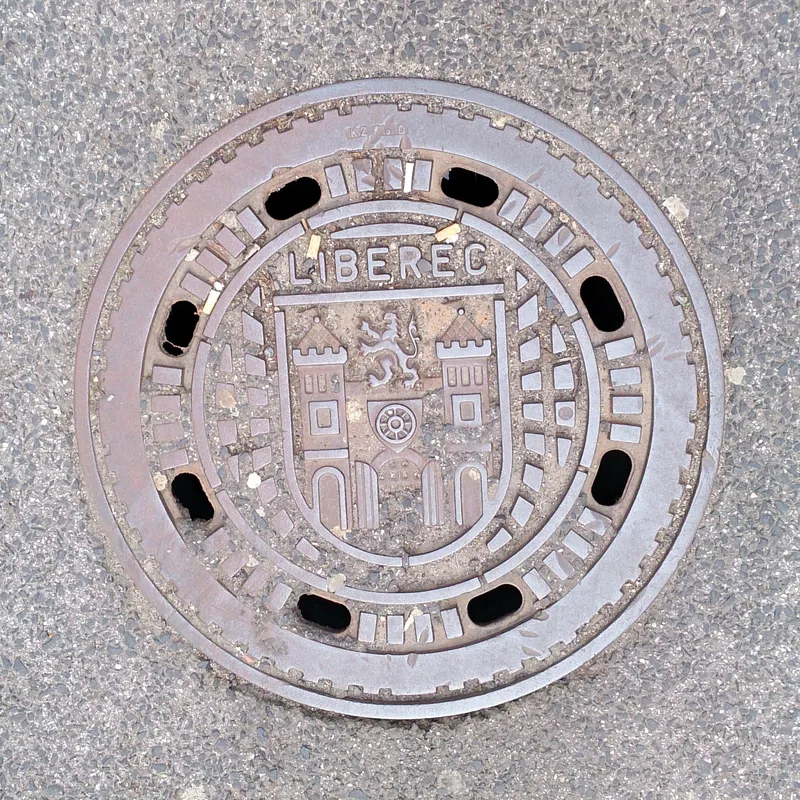
caryfukThe central armorial shield with the depiction of two towers, a lion in a leap and a cogwheel represents an interesting specimen of urban heraldry. Around this coat of arms is a circular inscription 'LIBEREC' and the outer edge is decorated with a repeating geometric pattern, which is typical of town hatches from the region. This artefact, set in an asphalt surface, shows signs of normal wear, but its structural integrity remains intact.
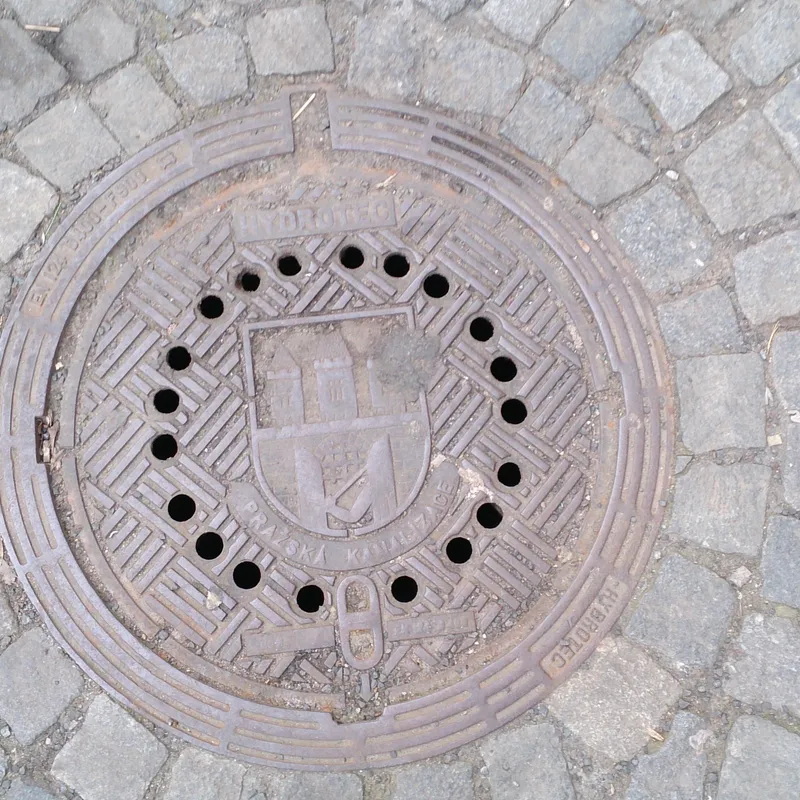
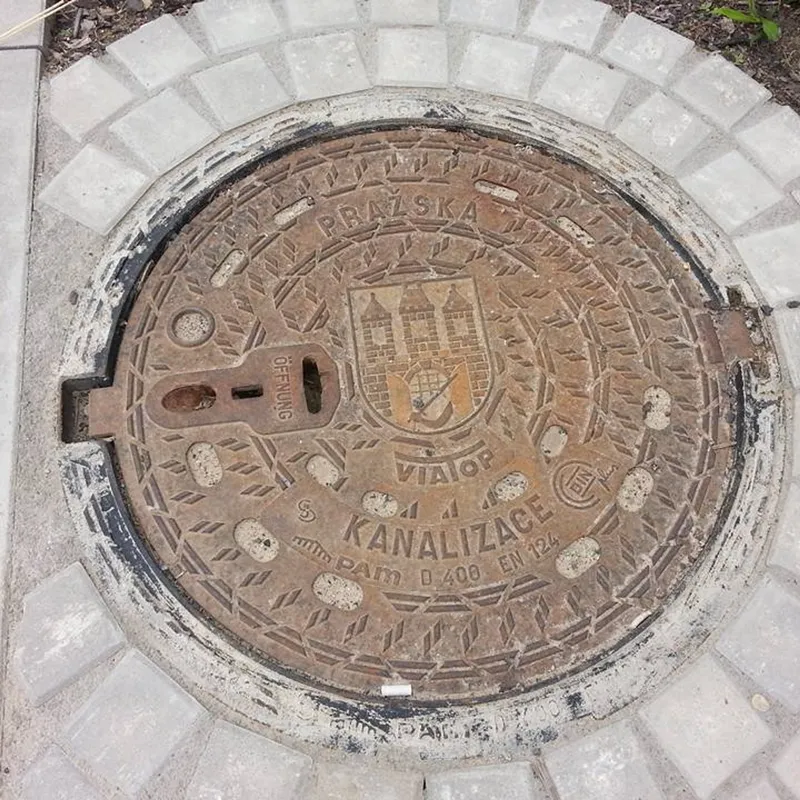
caryfukIn the centre of the circular specimen is the heraldic emblem of Prague, surrounded by the inscription 'PRAŽSKÁ KANALIZACE', which clearly identifies its municipal affiliation. The surface is further structured by a repeating diagonal geometric pattern, which seems to optimise traction while aesthetically complementing the functional design. This urban infrastructure artefact bears traces of wear and tear, indicating its long-term exposure to environmental influences.
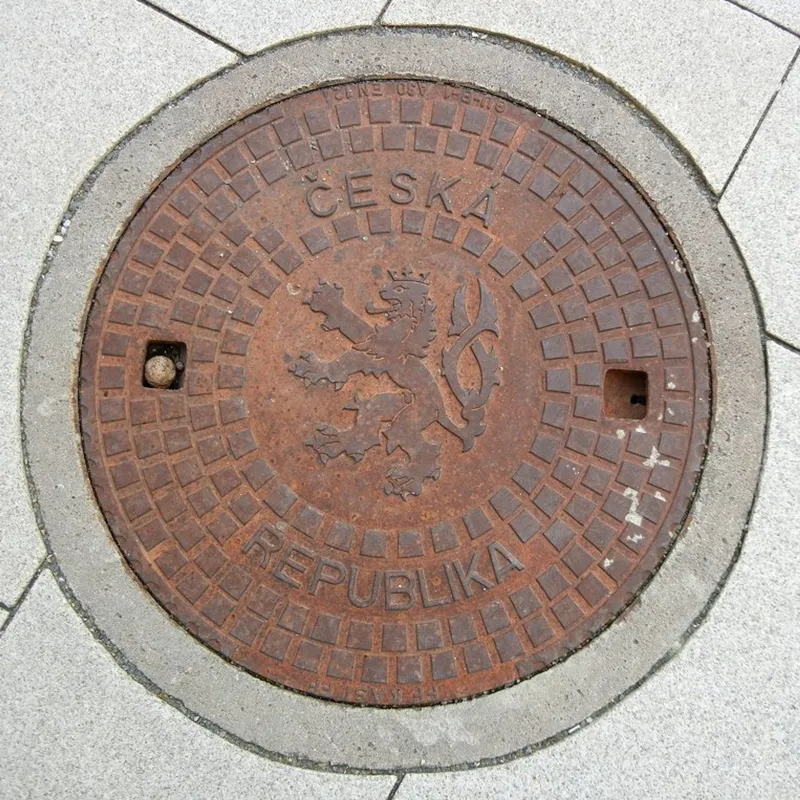
caryfukIn the centre of this robust specimen of a cast iron hatch, the heraldic lion, symbol of the Czech Republic, stands majestically surrounded by a precise geometric grid of squares. The inscriptions 'CZECH REPUBLIC' and 'D400' clearly identify its origin and robust construction class, making it a valuable artefact of urban infrastructure, worthy of study in the archives of the Institute of Humanology.
caryfukOn the circular cast-iron surface, the city emblem with a crowned lion and a unicorn dominates, surrounded by a diagonal pattern. The outer ring is decorated with a series of rectangular and square cutouts, which give this specimen an industrial aesthetic, worthy of careful study by the Institute of Lidology.
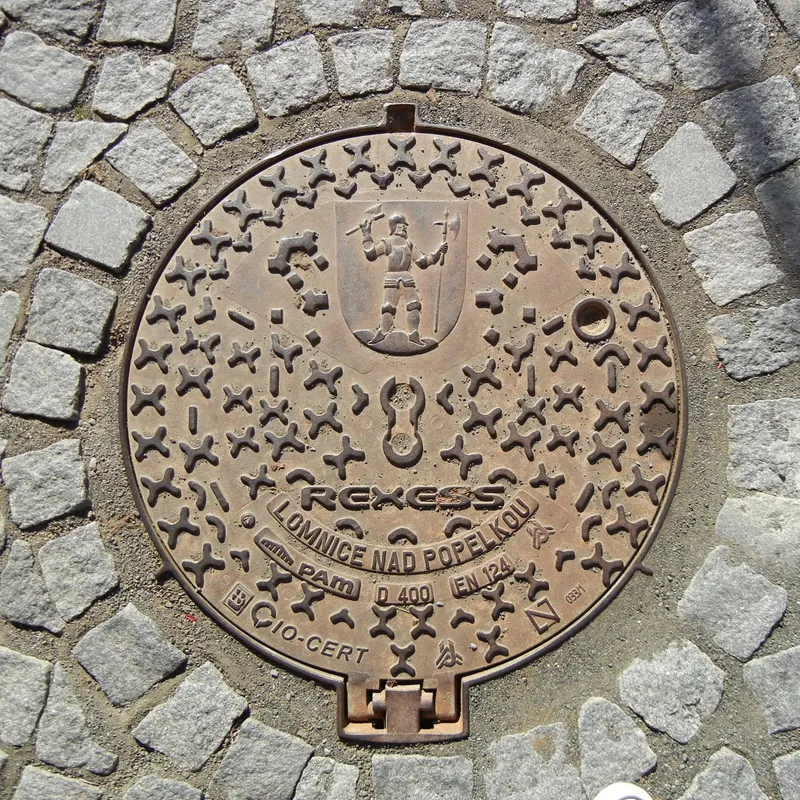
caryfukA central heraldic motif, depicting a figure with two axes, dominates this example of urban infrastructure, surrounded by a repeating pattern of stylised crosses. This hatch, set in a cobblestone surface, bears the inscription 'LOMNICE NAD POPELKOU', geographically anchoring its origin in the Czech Republic. From the point of view of philology, it is a fascinating artefact documenting local identity and technical norms.
caryfukThe round cast-iron artefact, surrounded by paving stones, bears a detailed municipal coat of arms in its centre. Epigraphic evidence on its surface reveals the inscriptions 'CITY' and 'CAMP', indicating its geographical affiliation, as well as technical specifications such as 'D400 EN 124'. This specimen, examined by the Institute of Lidology, represents a robust example of urban infrastructure designed for considerable loading.
caryfukThe centre of the circular cast-iron specimen is dominated by a detailed coat of arms, surrounded by inscriptions referring to the historic town. The surrounding paving of irregular stone blocks creates a contrasting frame, emphasising the industrial artefact in an urban setting. This hatch provides an interesting object for the study of urban infrastructure and heraldry, as the Institute of Lidology would confirm.
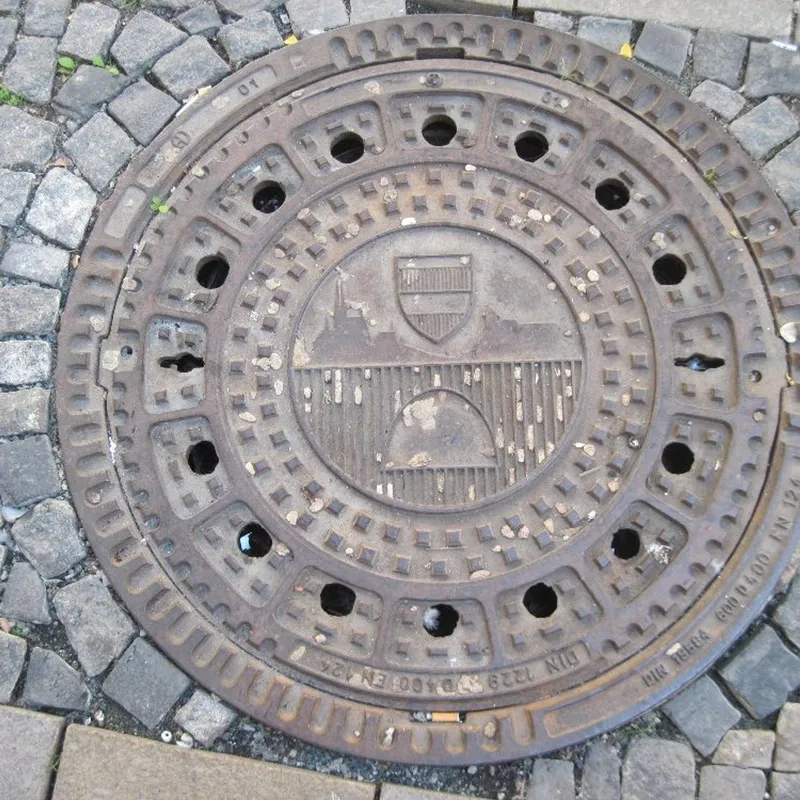
caryfukIn the centre of this specimen there is a distinctive city emblem with a coat of arms and a silhouette of buildings above the bridge structure, surrounded by concentric circles with geometric patterns of small squares and oval holes. The surface is much worn, indicating long exposure to urban traffic, and is set in a cobbled path of irregular stone blocks. The Institute of Lidology would classify this find as a typical example of urban infrastructure with heraldic elements.
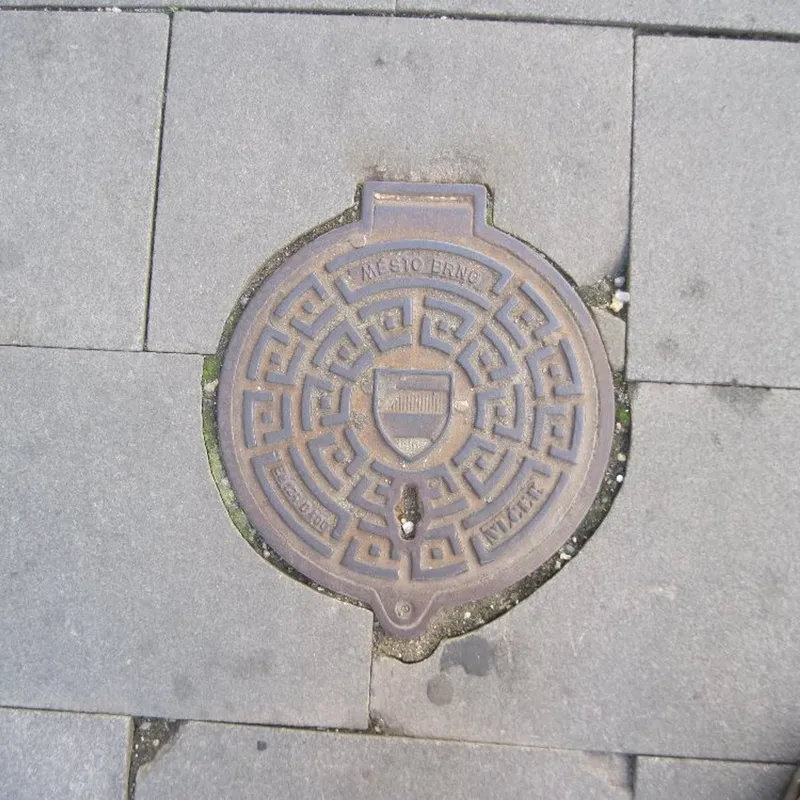
caryfukThis example of a cast iron hatch shows a heraldic shield with vertical hatching, surrounded by a complex geometric labyrinth. The inscription 'CITY OF BRNO' clearly identifies its geographical origin, while the marking 'EN 124 D400' suggests a robust construction for heavy loads. The Institute of Lidology would certainly appreciate this example of urban infrastructure.
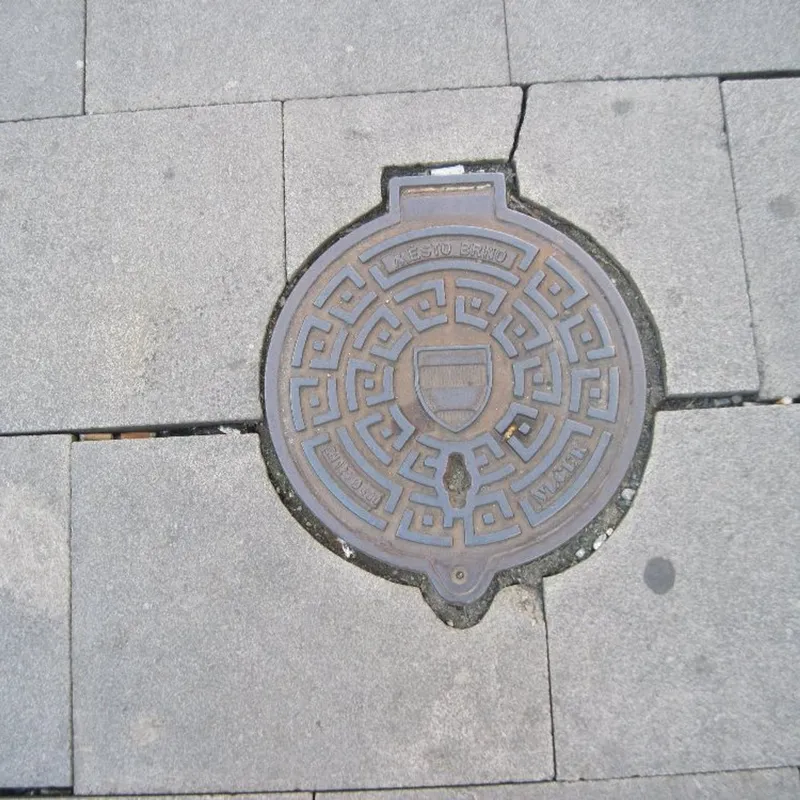
caryfukOn the surface of this specimen is a complex geometric pattern resembling a maze, which surrounds a central shield with horizontal stripes. The inscriptions 'CITY OF BRNO', 'ALAMEX' and 'D400' are clearly legible, indicating its urban origin, manufacturer and load class. The surrounding paving shows minor cracks indicative of normal wear and tear, which is of interest to the Institute of Lidology.
caryfukThe central armorial shield depicting the Prague Bridge and towers dominates this example of urban infrastructure. The surrounding geometric pattern and inscriptions such as 'PRAZSKA' and 'Kanalizace' clearly indicate its local affiliation and functional purpose. It is a robust cast iron artefact, classified for high load D400, which indicates its durability in an urban environment.
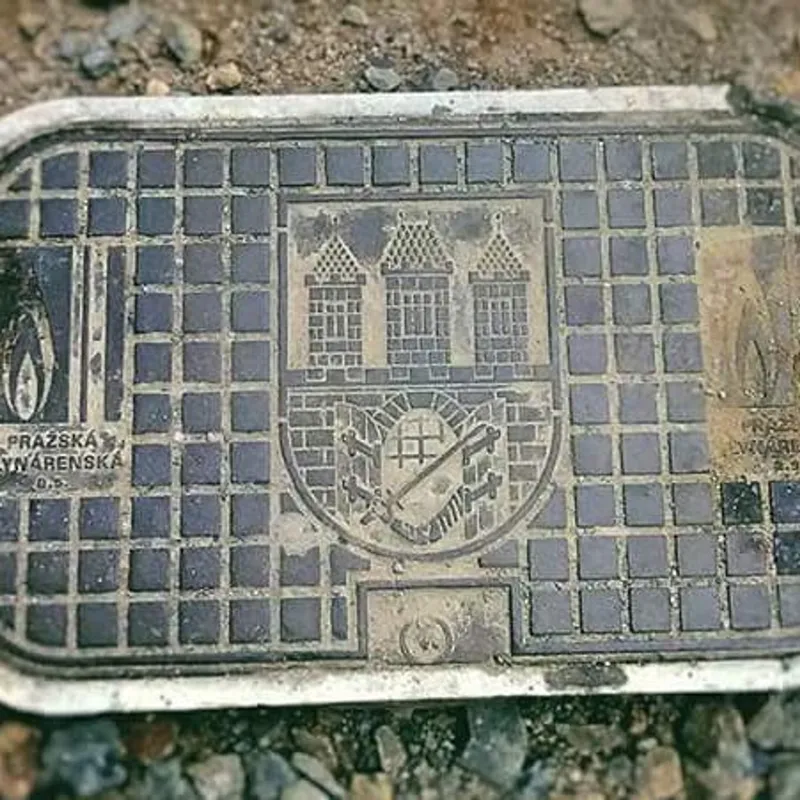
caryfukThe central coat of arms with three stylised houses and below it a cross and crossed swords dominates this rectangular example of urban infrastructure. Flame symbols are visible on the sides, accompanied by inscriptions referring to Prague's gas and waterworks, suggesting the dual functionality of this hatch. The Institute of Lidology would classify this artefact as a significant example of communal heraldry and utilitarian design from the turn of the century.
Strana 1 z 8 · 363 poklopů celkem