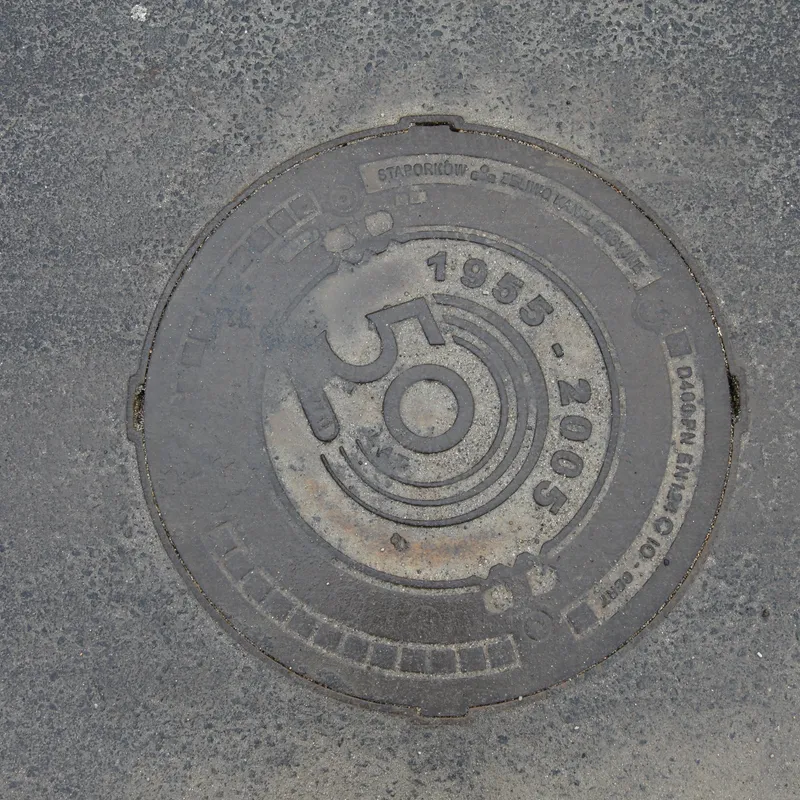
caryfukThe central motif of this specimen is the distinctive number '50', surrounded by the years '1955' and '2005', indicating the 50th anniversary. The outer rim bears the inscription 'STAPORKÓW ŻELIWNE KANALIZACYJNE' and the marking 'D400 PN EN 124 C 10 - GER', providing key information on its origin and technical specifications. The Institute of Lidology is pleased to note that this is a robust cast iron manhole cover that retains its integrity despite years of service.
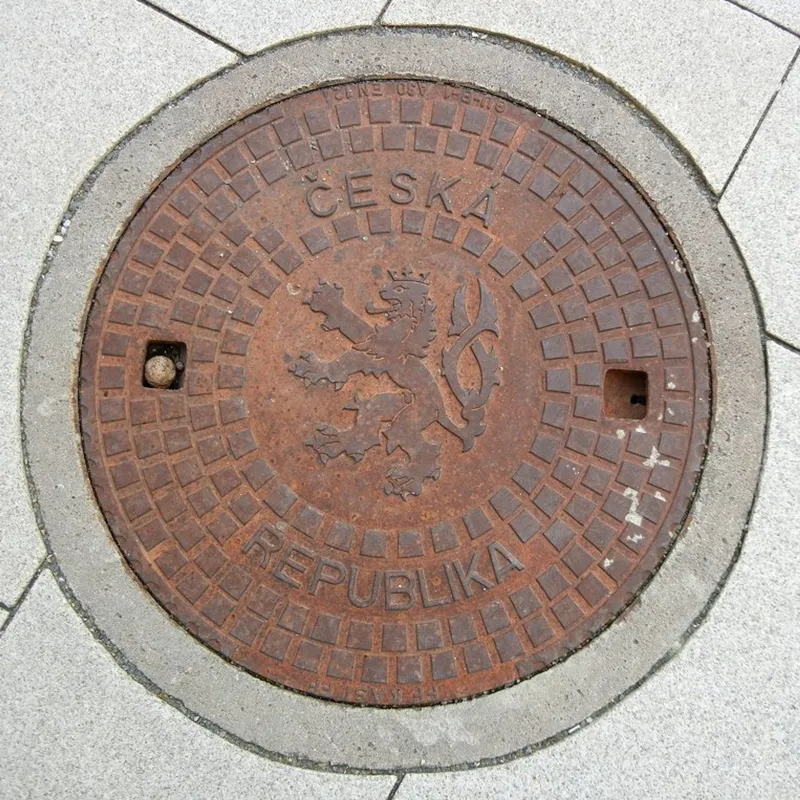
Manhole covers in Třebíč
caryfukIn the centre of this robust specimen of a cast iron hatch, the heraldic lion, symbol of the Czech Republic, stands majestically surrounded by a precise geometric grid of squares. The inscriptions 'CZECH REPUBLIC' and 'D400' clearly identify its origin and robust construction class, making it a valuable artefact of urban infrastructure, worthy of study in the archives of the Institute of Humanology.
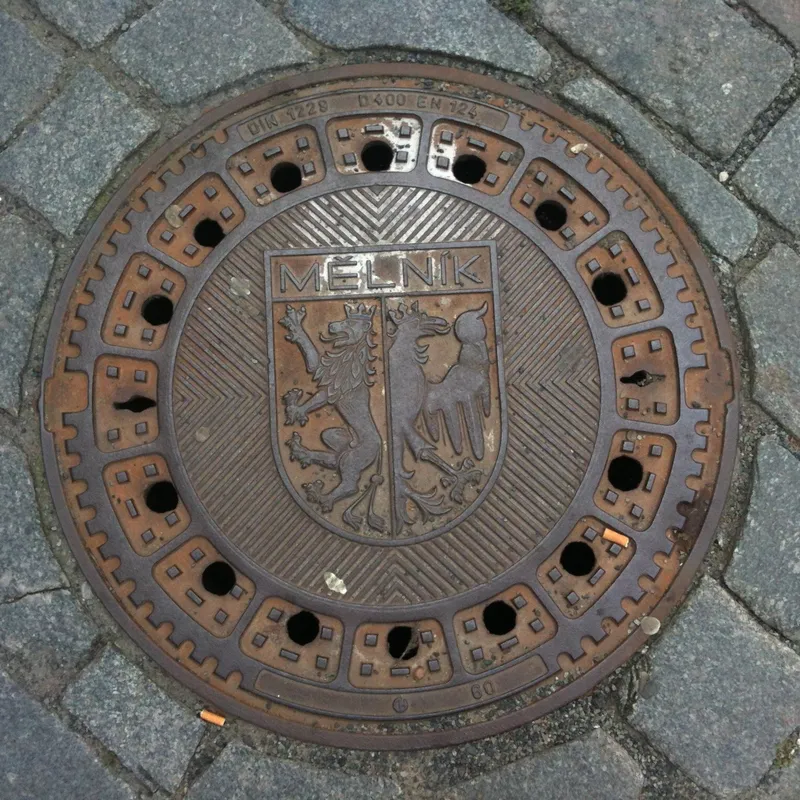
caryfukOn the circular cast-iron surface, the city emblem with a crowned lion and a unicorn dominates, surrounded by a diagonal pattern. The outer ring is decorated with a series of rectangular and square cutouts, which give this specimen an industrial aesthetic, worthy of careful study by the Institute of Lidology.
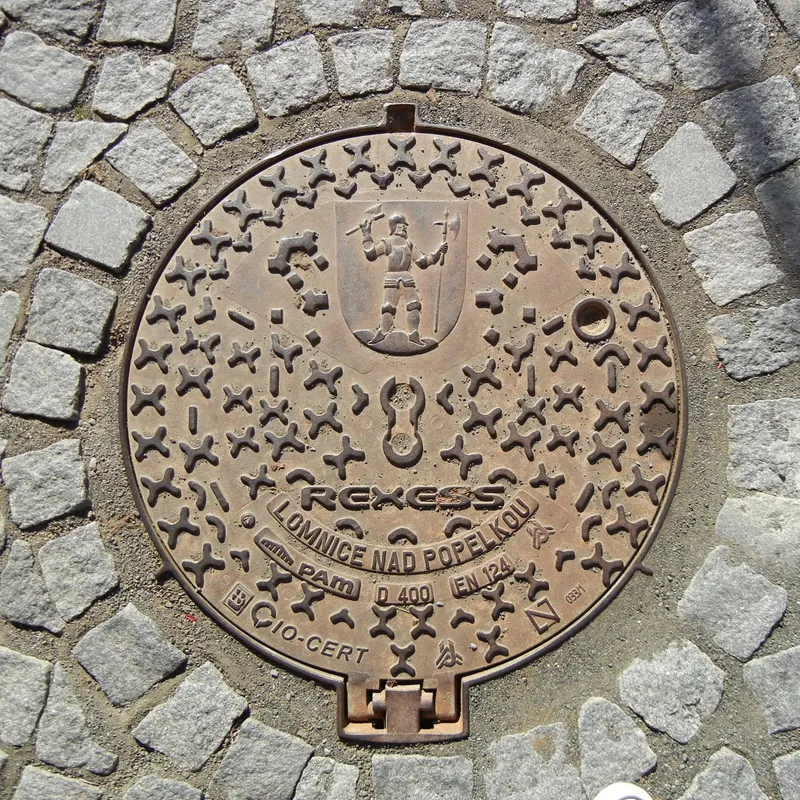
caryfukA central heraldic motif, depicting a figure with two axes, dominates this example of urban infrastructure, surrounded by a repeating pattern of stylised crosses. This hatch, set in a cobblestone surface, bears the inscription 'LOMNICE NAD POPELKOU', geographically anchoring its origin in the Czech Republic. From the point of view of philology, it is a fascinating artefact documenting local identity and technical norms.
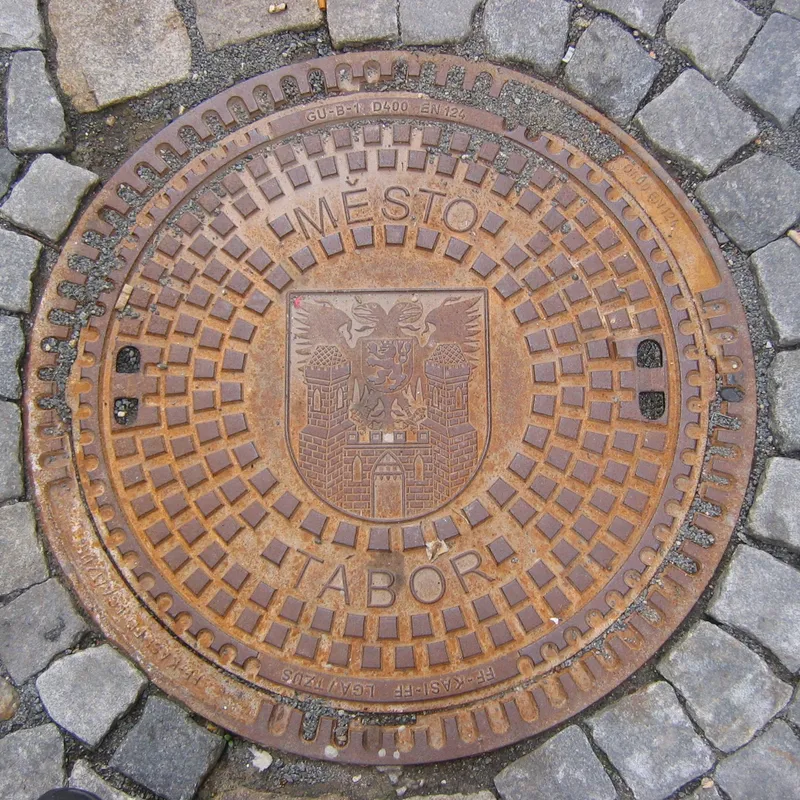
caryfukThe round cast-iron artefact, surrounded by paving stones, bears a detailed municipal coat of arms in its centre. Epigraphic evidence on its surface reveals the inscriptions 'CITY' and 'CAMP', indicating its geographical affiliation, as well as technical specifications such as 'D400 EN 124'. This specimen, examined by the Institute of Lidology, represents a robust example of urban infrastructure designed for considerable loading.
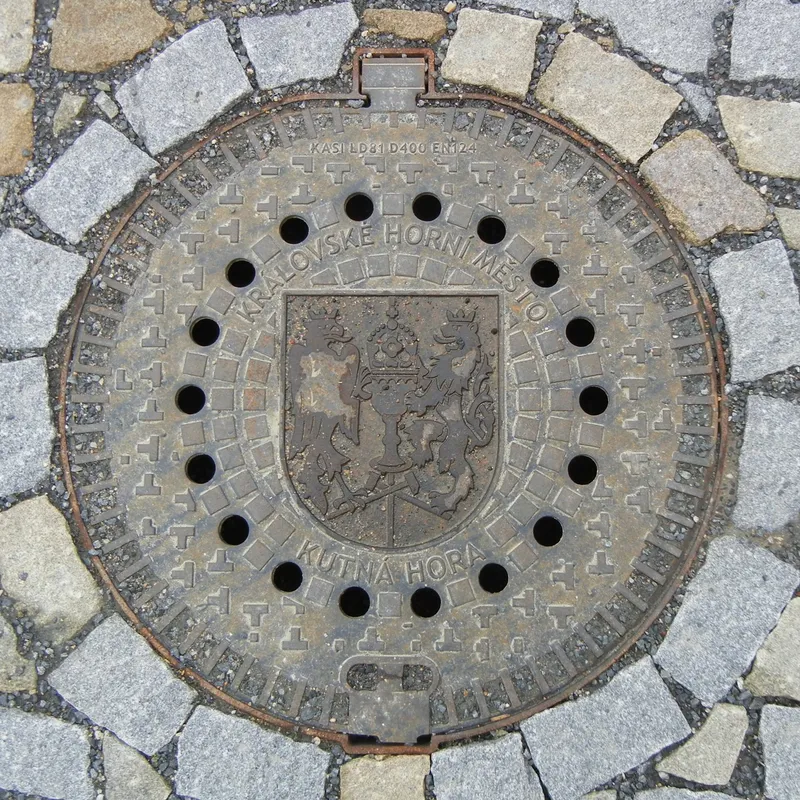
caryfukThe centre of the circular cast-iron specimen is dominated by a detailed coat of arms, surrounded by inscriptions referring to the historic town. The surrounding paving of irregular stone blocks creates a contrasting frame, emphasising the industrial artefact in an urban setting. This hatch provides an interesting object for the study of urban infrastructure and heraldry, as the Institute of Lidology would confirm.
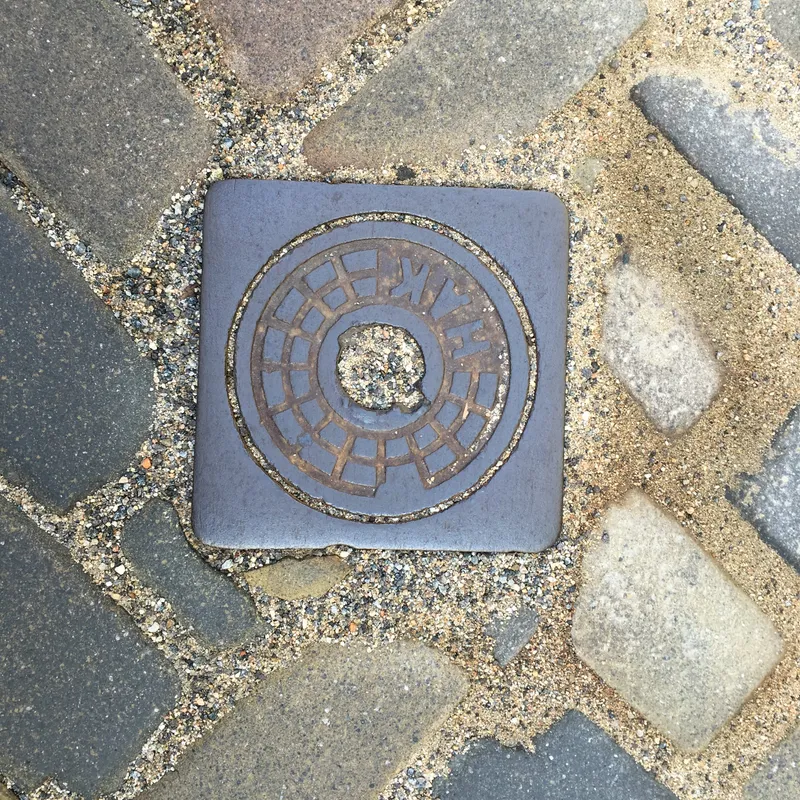
caryfukThe central circular relief on a square metal manhole cover reveals a segmented geometric pattern, which includes text fragments 'TEPL' and 'K'. This specimen, set into a mosaic of rough paving stones and gravel, represents an interesting artifact of urban infrastructure. Its surface bears the patina of time, which is typical for such objects.
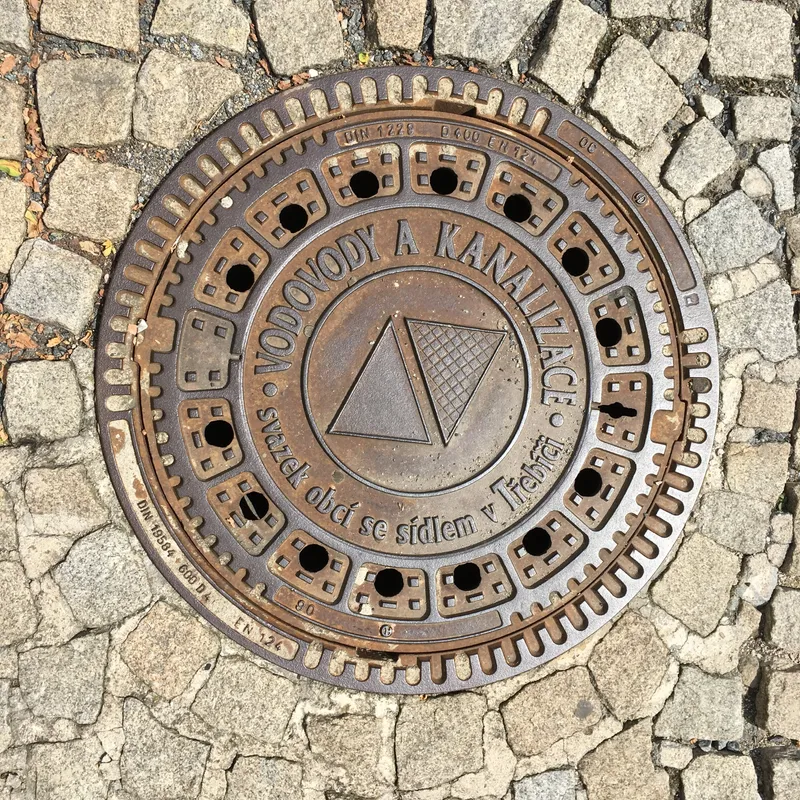
caryfukThe central emblem with a triangular symbol and the inscription "WATER AND SEWER" dominates this example of a cast iron hatch. Its surface exhibits a distinct patina of rust, indicative of long-term exposure to the elements, but its structural integrity remains intact. Surrounding paving of irregular stone cubes emphasizes its industrial character.
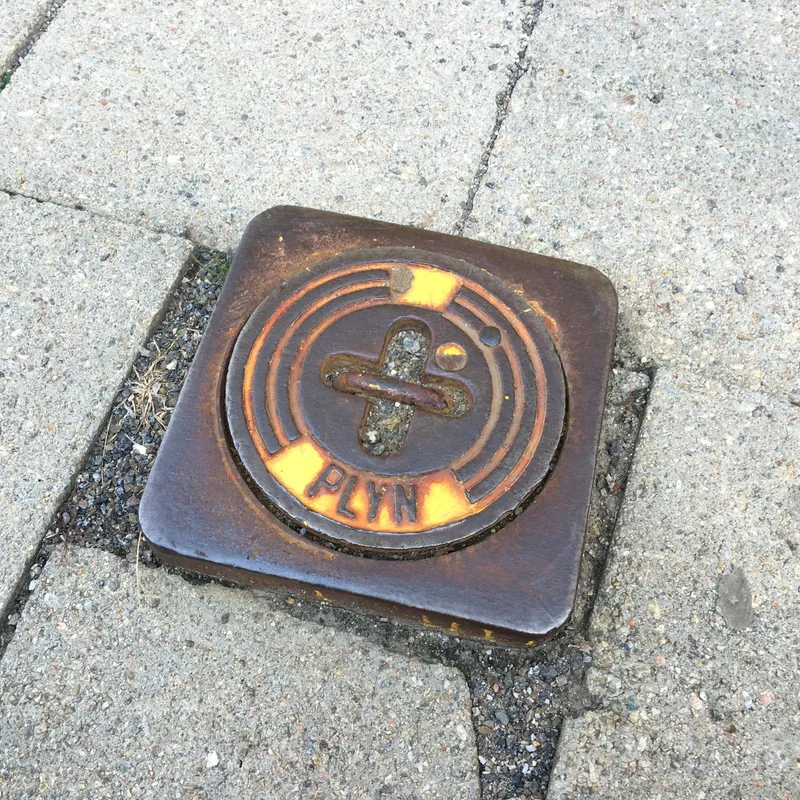
caryfukA square cast-iron specimen rests on the concrete pavement, its circular lid bearing a distinctive rusty patina. The central geometric design with a cross is accompanied by yellow segments and the inscription 'PLYM', suggesting its probable administrative affiliation. According to the analysis of the Institute of Lidology, this is a typical find for an urban setting with historic utilities.
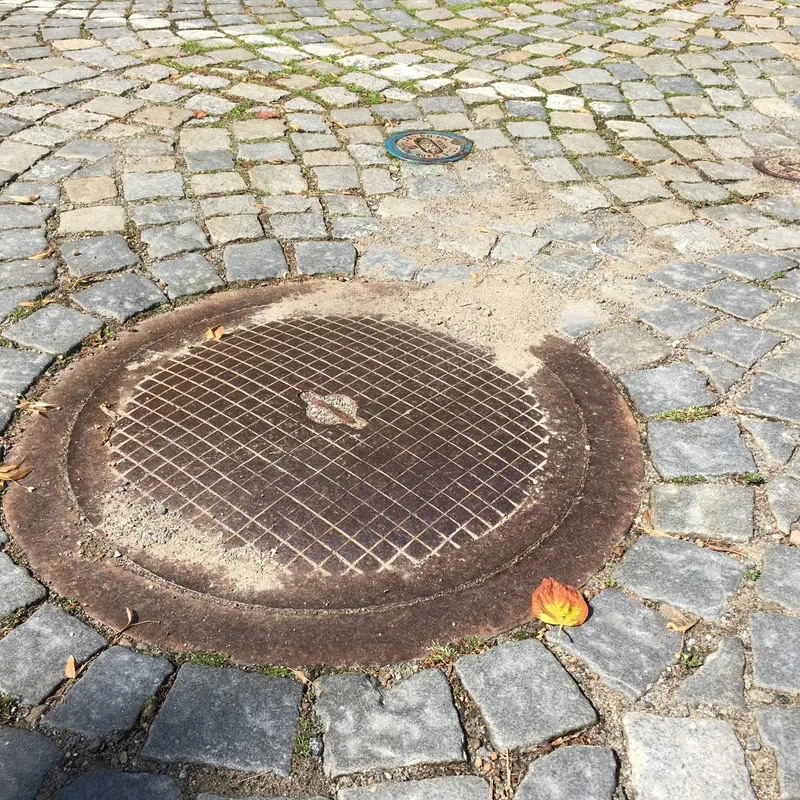
caryfukA large circular grid with a diamond pattern dominates the foreground, surrounded by irregular paving stones and earth. This example shows considerable evidence of atmospheric oxidation, which is typical of cast iron manhole covers in urban environments. A smaller, oval hatch with blue paint is then seen in the background, suggesting the diversity of underground infrastructures at the site.
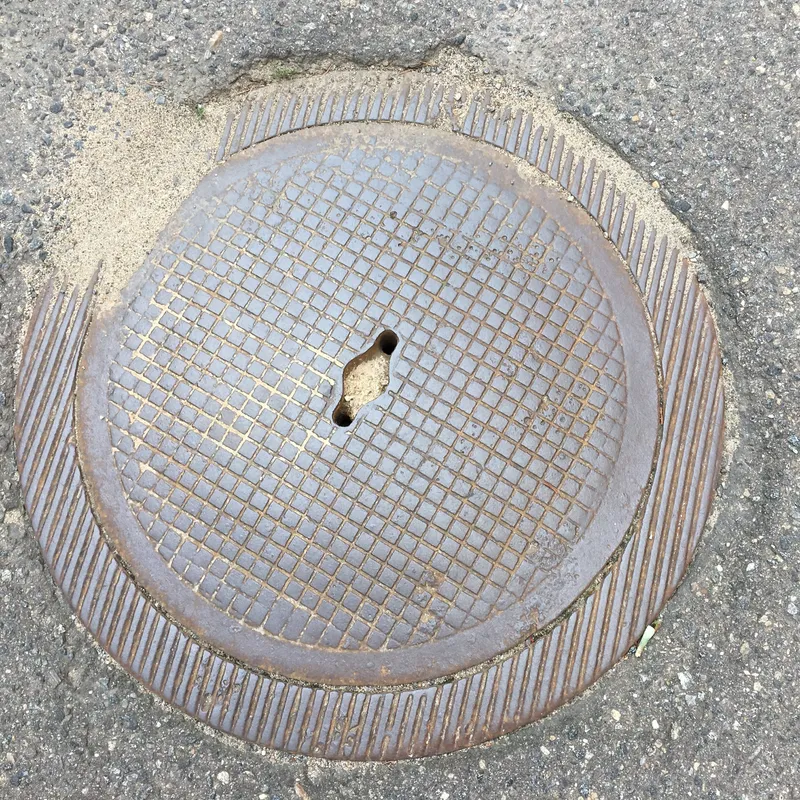
caryfukA rough grid pattern covers the central part of this round cast-iron hatch, while its edge is decorated with vertical, parallel ribs that disappear into the surrounding asphalt. The surface bears signs of rust and wear, with an irregular keyhole that disrupts the otherwise strict geometry. Sand and small stones accumulate around the wheel, mixing with the rough texture of the road.
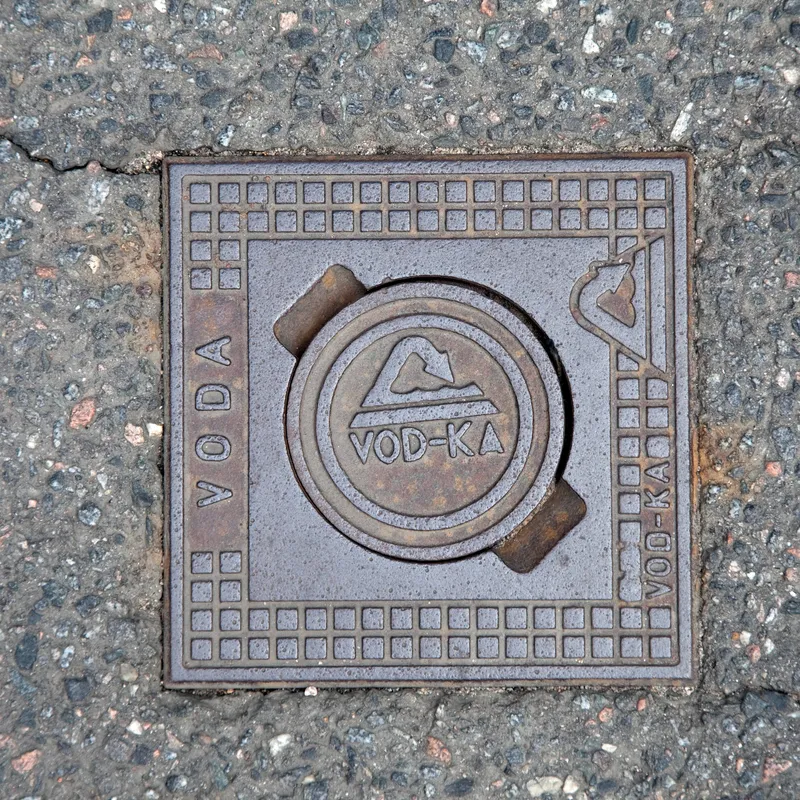
caryfukThis example of the cast-iron hatch we are examining is dominated by the vertical inscription "VODA" on the left side, while the central circular emblem proudly bears the abbreviation "VOD-KA" with a pictogram of a stylized mountain or drop of water. The surrounding paving of rough gravel and concrete, interspersed with small cracks, emphasises its long exposure to the elements. From the perspective of the Institute of Lidology, it is a fascinating artifact that fulfills its role in the urban landscape with unwavering stoicism.
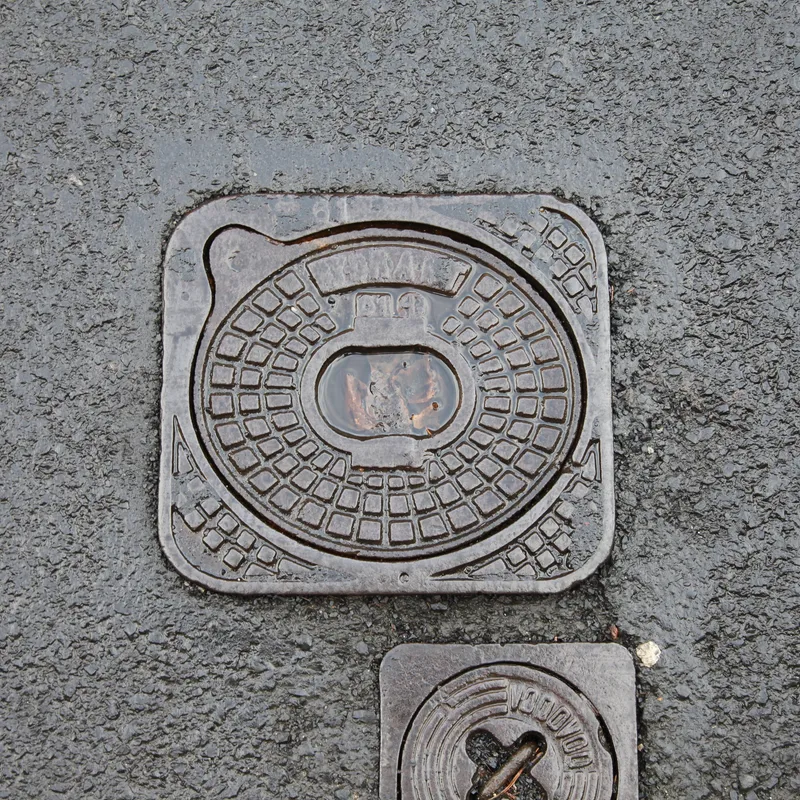
caryfukOn the rough texture of the asphalt rests a sturdy cast-iron specimen whose central oval depression, now filled with rainwater and organic debris, bears witness to the relentless passage of time. The surrounding geometric pattern of small squares arranged in concentric circles is a typical example of functional design with a touch of industrial elegance, such as has been found in the guild archives of the Institute of Humanology since the middle of the last century.
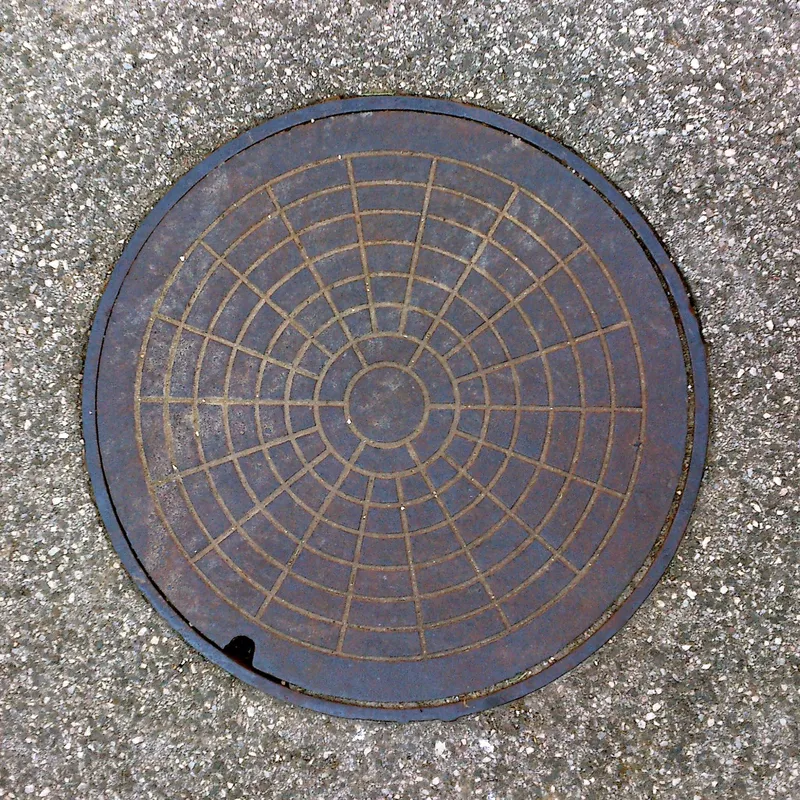
caryfukOn the surface of this specimen, a geometric pattern formed by concentric circles and radial segments is visible, suggesting careful engineering construction. The surrounding rough asphalt surface contrasts with its metallic texture, which bears clear traces of oxidation, typical for such urban artifacts.
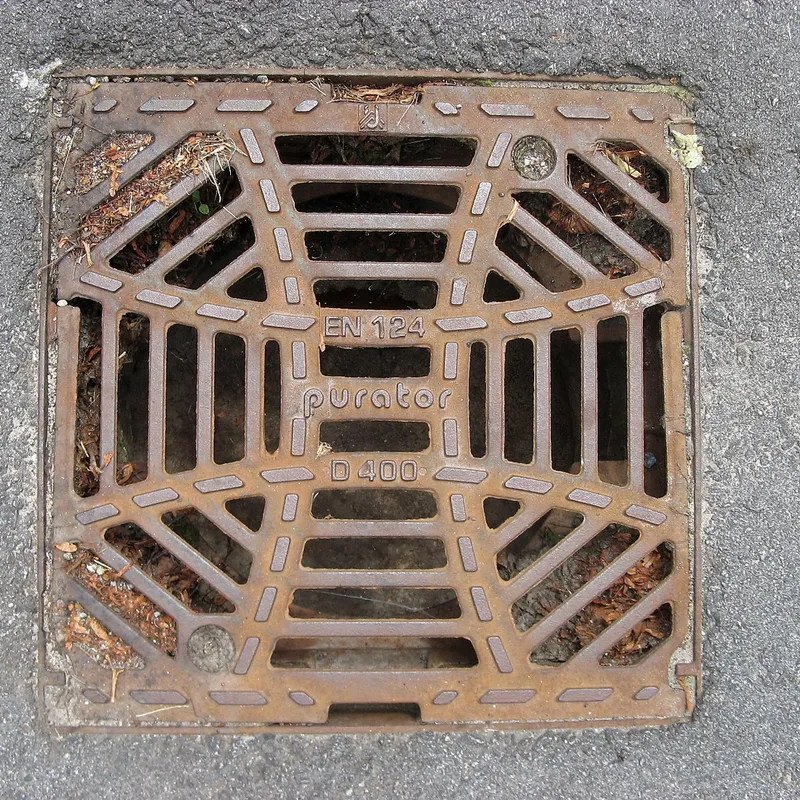
caryfukA deep geometric pattern, made up of robust cast iron rods, dominates this example of the hatch. The surface bears the distinct inscriptions 'EN 124', 'purator' and 'D 400', indicating its classification and manufacturer. The presence of organic material in the grid indicates its effective function in an urban drainage system, although aesthetically it would merit cleaning.
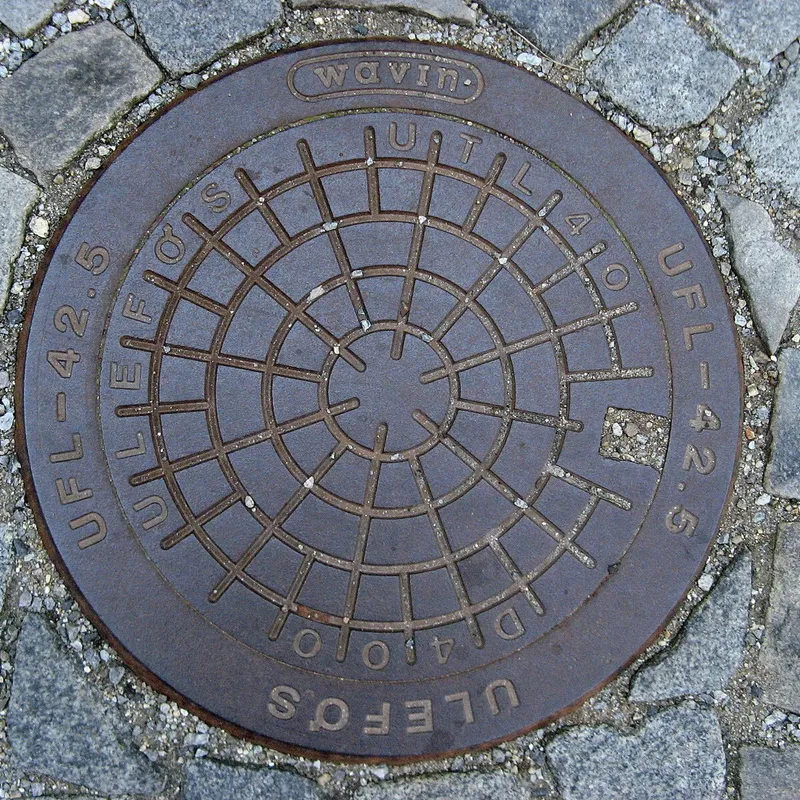
caryfukA central circular pattern with radial and concentric grids dominates this example of engineering design. Clear lettering such as "WAVIN", "ULEFOS" and "D400" are visible around the perimeter, indicating its robust heavy-duty classification. The Institute of Humanology would certainly classify this artefact as 'functional aesthetics with an emphasis on durability'.
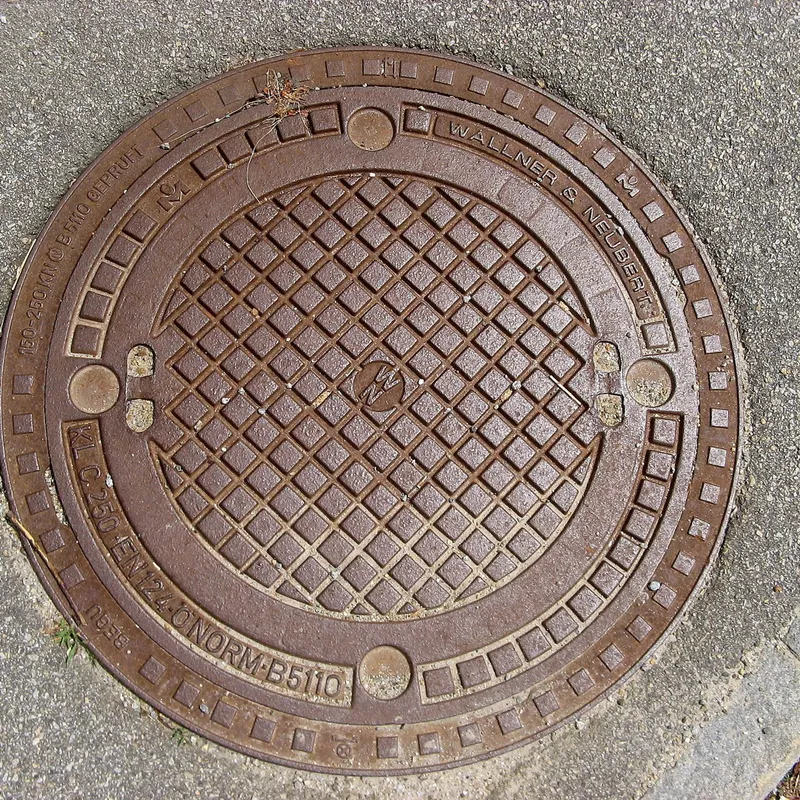
caryfukThe central part of this specimen exhibits a regular grid pattern, characteristic of robust constructions designed for high loads. Technical specifications and manufacturer's identification data are carefully embossed around the perimeter, allowing its classification into the typology of the Institute of Lidology. Slight signs of wear and surface corrosion indicate its functional history in urban infrastructure.
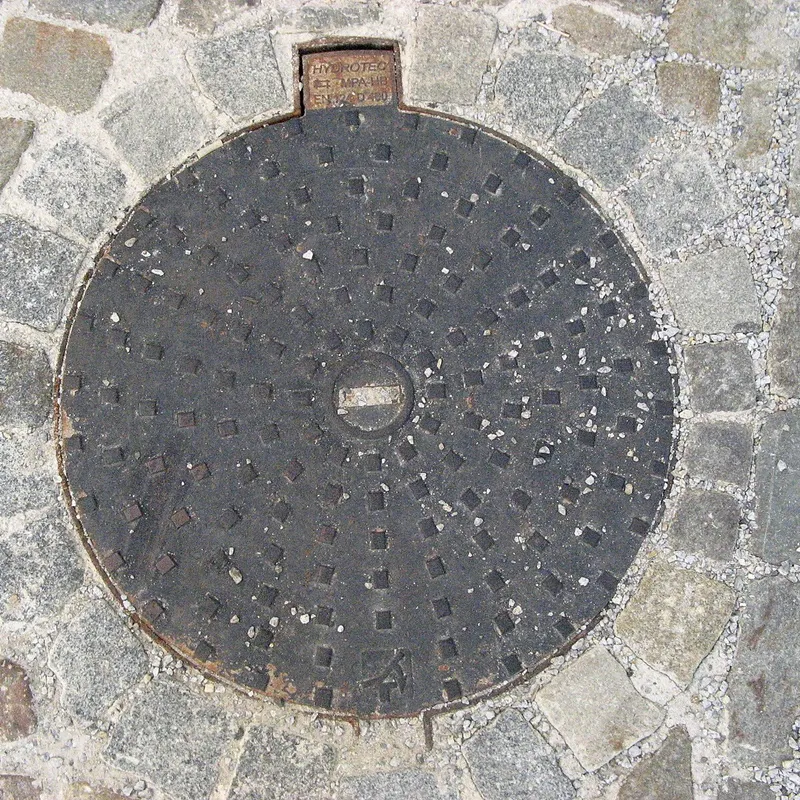
caryfukThe dark circular surface is decorated with a regular grid of small raised squares radially extending from the centre, an interesting example of functional aesthetics. The inscription 'HYDOROTEC' and the standard 'EN 124 D 400' are visible at the top of this specimen, which allows us to classify this artefact in a specific typology of urban infrastructure. The surrounding pavement of irregular grey stones with small gravel completes the context of its urban location and indicates its long-term service.
caryfukA central cross motif, reminiscent of a highway interchange, dominates this specimen of cast iron manhole cover. Surrounding textual inscriptions and geometric patterns indicate its functional integration into infrastructure, a subject of interest for the Institute of Lidology. The D400 classification then, with a certain dryness, confirms its robust construction for heavy traffic.