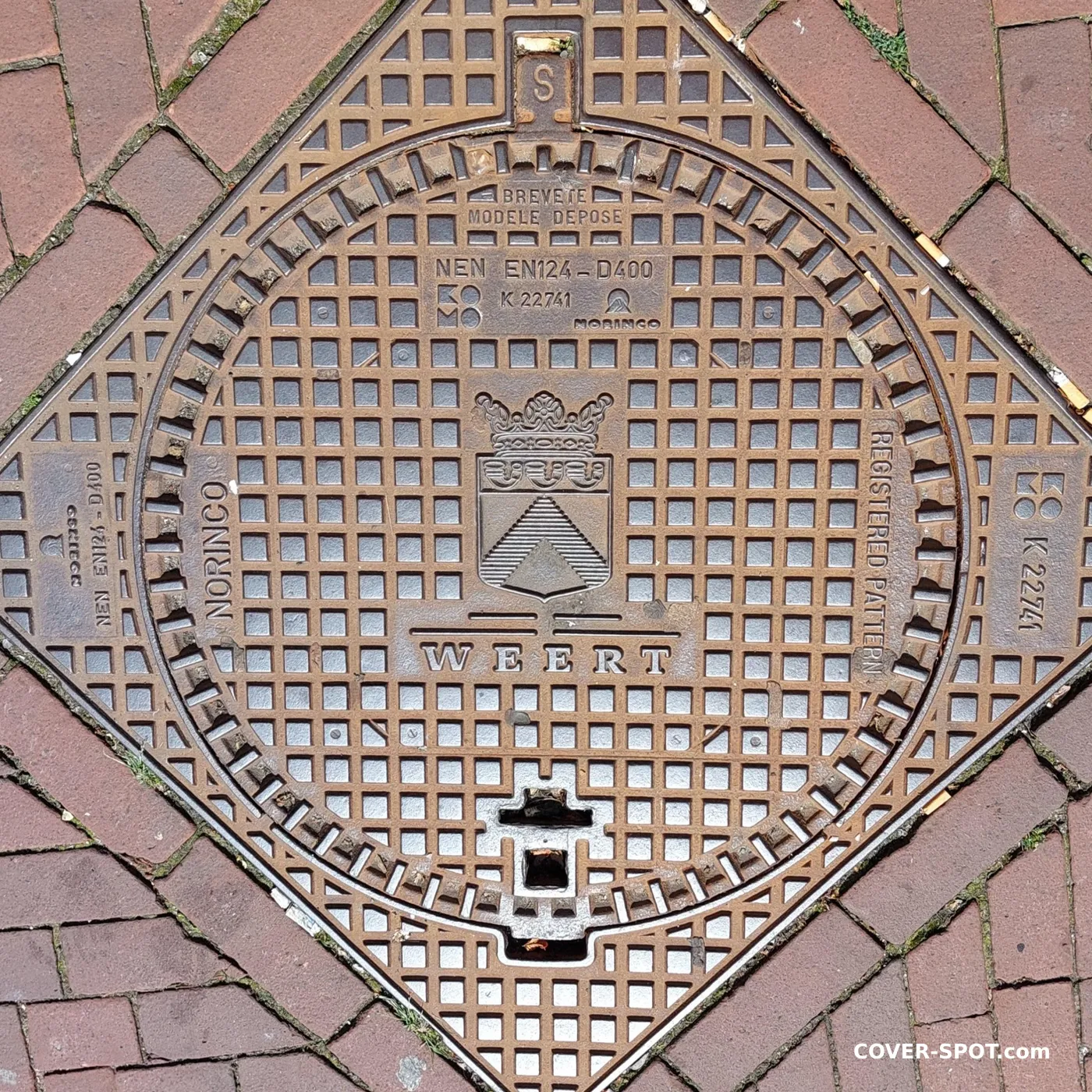
Manhole cover in 05, The Netherlands

etienne-van-den-hombergh
Photographer
The coats of arms of Dutch municipalities are all described on the Wikipedia page “Coats of Arms from A to Z,” including that of the municipality of Weert. Here is a brief explanation of two notable elements. In heraldry, the inverted V is called a chevron, and in the textile world, a chevron is a weaving pattern. Weert had a thriving cloth industry in the late Middle Ages. The three horns above the chevron refer to the Counts of Horn, who ruled Weert for a long time. One of these counts is all too well known in the Netherlands from our national history: in 1568, he was beheaded on the Grand Place in Brussels for rebelling against Philip II.
De wapens van Nederlandse gemeenten staan allemaal beschreven op de Wikipagina Wapens van A tot Z. Dus ook die van de gemeente Weert. Twee opvallende elementen kort toegelicht. De omgekeerde V wordt in de heraldiek een keper genoemd en in de textielwereld is een keper een weefselpatroon. Weert kende in de late middeleeuwen een levendige lakenindustrie. De drie hoorns boven de keper verwijzen naar de graven van Horn die lange tijd het gezag uitoefenden in Weert. Eén van die graven kennen we in Nederland maar al te goed uit de vaderlandse geschiedenis: in 1568 werd hij op de Grote Markt van Brussel onthoofd vanwege rebellie tegen Filips II.
Cover Detail
Shape
Round
Design Style
City Coat of Arms
Condition
Good
Manufacturer
Norinco
Inscriptions
Weert
ID
9350963703